
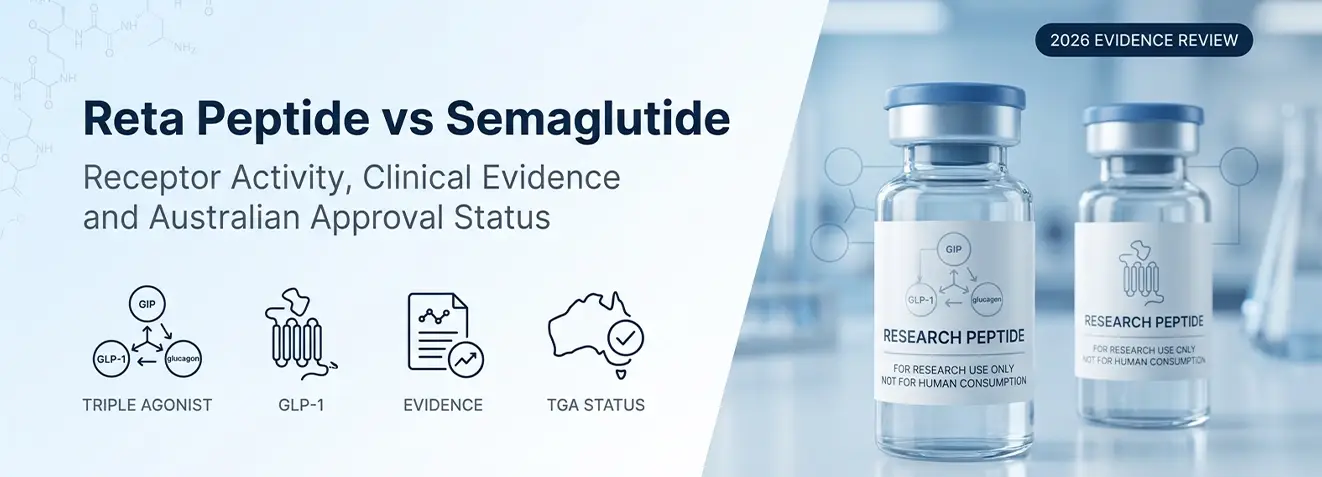
Reta peptide vs semaglutide is a comparison between retatrutide, an investigational triple-receptor agonist, and semaglutide, an approved GLP-1 receptor agonist.
Retatrutide activates GIP, GLP-1, and glucagon receptors, while semaglutide primarily targets GLP-1.
Semaglutide has a more established clinical and safety record, whereas retatrutide remains investigational and is not TGA approved.
Because the available results come from separate trials, they do not establish which compound is safer or more effective.
Key Takeaways
- Retatrutide targets three receptors; semaglutide targets GLP-1.
- Semaglutide has approved products and longer safety follow-up.
- Retatrutide remains investigational and is not TGA approved.
- No completed head-to-head trial is currently available.
What Is Reta Peptide, or Retatrutide?
Reta peptide, covered further in our reta peptide information guide, usually refers to retatrutide, a synthetic peptide developed under the identifier LY3437943. It is designed as a single molecule that activates three metabolically relevant receptors:
- GIP receptor: involved in incretin signalling and glucose-dependent insulin secretion
- GLP-1 receptor: associated with glucose regulation, satiety and reduced energy intake
- Glucagon receptor: involved in hepatic glucose and lipid metabolism and potentially energy expenditure
For this reason, retatrutide is described as a GIP/GLP-1/glucagon triple-receptor agonist. It is not scientifically classified as “GLP-3”, a term sometimes used online but not recognised as an accurate pharmacological category.
What Is Semaglutide and How Does It Work?
Semaglutide is a modified, long-acting GLP-1 receptor agonist.
Its modified structure prolongs its activity compared with native GLP-1 and supports longer-lasting receptor activation.GLP-1 receptor signalling is associated with:
- Increased glucose-dependent insulin secretion
- Reduced glucagon secretion when glucose is elevated
- Greater satiety and lower energy intake
- Appetite-related signalling in the central nervous system
- Delayed gastric emptying, with the effect often most marked earlier in exposure
- Changes in several cardiometabolic risk markers
Semaglutide has been investigated across extensive diabetes, chronic weight-management and cardiovascular-outcome programmes. Its evidence base includes randomised trials and safety monitoring after approval.

Reta Peptide vs Semaglutide: Quick Comparison
| Comparison Point | Retatrutide | Semaglutide |
| Pharmacological class | Triple-receptor peptide agonist | GLP-1 receptor agonist |
| Principal receptor activity | GIP, GLP-1 and glucagon | GLP-1 |
| Development status | Investigational | Approved formulations exist |
| Australian status at review date | Not TGA approved | Registered prescription products exist for specific indications |
| Evidence maturity | Peer-reviewed Phase 2 evidence plus Phase 3 topline findings | Multiple Phase 3 programmes, outcome trials and post-marketing data |
| Direct comparison between the two | No completed head-to-head trial | No completed head-to-head trial |
| Approved therapeutic dosing | No approved retatrutide dose | Depends on the registered product and indication |
| Major research areas | Weight regulation, glycaemia, energy balance, liver fat and obesity complications | Type 2 diabetes, chronic weight management and cardiovascular outcomes |
Differences in dose, receptor activity, participant characteristics and tolerability can all affect trial outcomes.
Safety and Side Effects of Retatrutide vs Semaglutide
Both retatrutide and semaglutide may cause gastrointestinal side effects, particularly during dose escalation. Commonly reported effects include:
- Nausea
- Diarrhoea
- Vomiting
- Constipation
- Abdominal discomfort
Despite this overlap in gastrointestinal effects, the two compounds have different levels of safety evidence and regulatory monitoring.
1. Retatrutide Safety Profile
Reported reta peptide side effects include gastrointestinal effects and dose-dependent increases in heart rate. Because retatrutide remains investigational, uncommon and long-term risks are still uncertain, and no post-marketing safety data are available.
2. Semaglutide Safety Profile
Semaglutide has a more established safety profile based on randomised trials, approved Australian Product Information and post-marketing monitoring.
Gastrointestinal adverse effects are common, while product-specific warnings include pancreatitis, gallbladder disease, dehydration-related kidney complications, diabetic retinopathy complications in susceptible patients and delayed gastric emptying.
Australian Product Information also includes warnings concerning pulmonary aspiration during general anaesthesia or deep sedation, psychiatric symptoms and the rare eye disorder NAION.
How Do Retatrutide and Semaglutide Receptor Mechanisms Differ?
Semaglutide and Selective GLP-1 Signalling
Semaglutide binds to and activates the GLP-1 receptor. In pancreatic beta cells, this increases cyclic adenosine monophosphate, or cAMP, signalling and supports insulin secretion when glucose is available. GLP-1 activity also affects alpha-cell glucagon signalling, gastrointestinal motility and appetite-related neural pathways.
This selectivity distinguishes semaglutide from compounds designed to activate GIP or glucagon receptors alongside GLP-1.
How Does Retatrutide Balance Three Receptor Pathways?
Retatrutide combines three receptor activities:
- GLP-1 agonism supports glucose-dependent insulin signalling, satiety and reduced energy intake.
- GIP agonism may influence insulin secretion, adipose-tissue biology and metabolic flexibility.
- Glucagon-receptor activation may affect hepatic lipid metabolism and energy expenditure, while also influencing glycaemic and cardiovascular parameters.
Retatrutide’s biological effects depend on the relative activity of its three receptor pathways rather than on the number of receptors alone.
What Does Current Retatrutide Research Show?
A peer-reviewed Phase 2 retatrutide trial reported a mean body-weight reduction of 24.2% at 48 weeks at the highest maintenance dose, alongside gastrointestinal adverse events and dose-dependent increases in heart rate.
Lilly later reported positive retatrutide Phase 3 results across several TRIUMPH trials, with mean reductions ranging from 20.8% to 28.7% in different study populations. However, some findings remain manufacturer-reported rather than fully peer-reviewed.
What Does Semaglutide Research Show?
In the STEP 1 semaglutide trial, semaglutide 2.4 mg plus lifestyle intervention produced a mean body-weight change of −14.9% at 68 weeks, compared with −2.4% for placebo.
Semaglutide has also been evaluated in diabetes, cardiovascular and kidney outcome trials, giving it a broader clinical evidence base than retatrutide.
Can Retatrutide and Semaglutide Results Be Compared Directly?
No. Their reported percentages come from separate trials with different populations, durations, doses, lifestyle programmes and analysis methods.
The same limitations apply when comparing results from separate trials of other multi-receptor agonists, including mazdutide.
Reta Peptide vs Ozempic: What Is the Difference?
Ozempic is an approved brand-name medicine containing semaglutide, whereas Reta Peptide refers to investigational retatrutide..
Reta Peptide refers to retatrutide, while Ozempic is a brand-name medicine containing semaglutide.
Ozempic is registered in Australia for type 2 diabetes, whereas Wegovy contains the same active ingredient but is approved for chronic weight management.
Retatrutide remains investigational and has no TGA-approved branded medicine.
These differences in evidence and regulatory status are essential when interpreting claims about the two compounds.
Australian regulations also restrict public advertising of prescription medicines and unapproved therapeutic goods.
Reta Peptide vs Tirzepatide and Semaglutide
Retatrutide targets GIP, GLP-1 and glucagon receptors; tirzepatide targets GIP and GLP-1, while Semaglutide selectively activates the GLP-1 receptor.
The additional receptor targets do not by themselves establish greater clinical benefit.
| Comparison Point | Semaglutide | Tirzepatide | Retatrutide |
| Receptor activity | GLP-1 | GIP and GLP-1 | GIP, GLP-1 and glucagon |
| Agonist type | Single agonist | Dual agonist | Triple agonist |
| Australian status | Approved products exist | Mounjaro is approved for specified indications | Investigational and not TGA approved |
| Evidence maturity | Extensive clinical and post-marketing evidence | Established clinical evidence | Emerging clinical evidence without post-marketing data |
| Direct comparison | Compared directly with tirzepatide | Compared directly with semaglutide | No completed direct comparison with either compound |
| Long-term safety data | Most established | Available but less extensive | Still being evaluated |
| Approved therapeutic dose | Product-specific approved doses exist | Product-specific approved doses exist | No approved therapeutic dose |
Tirzepatide targets GIP and GLP-1 peptide receptors, while retatrutide adds glucagon receptor activity to these two pathways.
How Should Researchers Compare Reta Peptide and Semaglutide?
Meaningful comparisons depend on receptor activity, study population, measured outcomes, trial duration and analysis methods.
Results from separate studies describe each compound within its original trial setting and do not establish direct superiority or equivalent safety.
The Australia Peptide Sciences research-use-only peptide guide explains the distinction between laboratory research, investigational evidence and approved therapeutic use.

Final Comparison: Reta Peptide vs Semaglutide
Overall, the Reta Peptide vs semaglutide evidence highlights important differences in receptor activity, clinical development and Australian regulatory status.
Retatrutide (Or Reta Peptide) targets GIP, GLP-1 and glucagon receptors but remains investigational and is not TGA approved. Semaglutide primarily targets GLP-1 and is supported by more extensive clinical, regulatory and post-marketing evidence.
These differences should be interpreted within the context of study design and approved use rather than as proof of universal clinical superiority.
FAQs About Reta Peptide vs Semaglutide
What’s better, semaglutide or retatrutide?
Current evidence does not identify one as better overall; retatrutide has produced greater weight reductions in separate trials, while semaglutide has approved uses and a more established safety record.
How do retatrutide and semaglutide safety findings compare?
No evidence proves retatrutide is safer than Ozempic, as retatrutide remains investigational and lacks semaglutide’s long-term post-marketing safety data.
Do trial results show other peptides outperform semaglutide?
No. Semaglutide is itself a peptide-based GLP-1 analogue, and peptides cannot be treated as a single category with one level of effectiveness.
Is it okay to switch from semaglutide to retatrutide?
Retatrutide is not TGA-approved, so switching should never be attempted independently and would require a qualified clinician and a lawful, authorised access pathway.
Is retatrutide approved for routine use?
Retatrutide has no complete approved contraindication profile because it remains investigational; it should not be self-administered or obtained from unapproved suppliers.
How quickly does retatrutide work?
Retatrutide produces progressive changes, with clinical trials measuring substantial weight reduction over approximately 24 to 80 weeks.
Which incretin-based medicine has the strongest safety evidence?
There is no universally safest weight-loss injection; the safest option is an approved medicine selected and monitored by a qualified healthcare professional.
Is retatrutide bad for the kidneys?
Retatrutide has not been established as directly toxic to the kidneys, but evidence remains incomplete and gastrointestinal fluid loss may cause dehydration that worsens kidney function in susceptible people.
What do trials report after retatrutide is discontinued?
Retatrutide-specific withdrawal data remain limited, but appetite and weight may increase after treatment stops, as observed with other incretin-based therapies.
Can any peptide selectively target abdominal fat?
No peptide selectively targets belly fat; reductions in abdominal fat occur as part of overall weight loss rather than spot reduction.
References
Triple-Hormone-Receptor Agonist Retatrutide for Obesity: A Phase 2 Trial.
TRIUMPH-1: A Phase 3 Study of Retatrutide in Participants with Obesity.