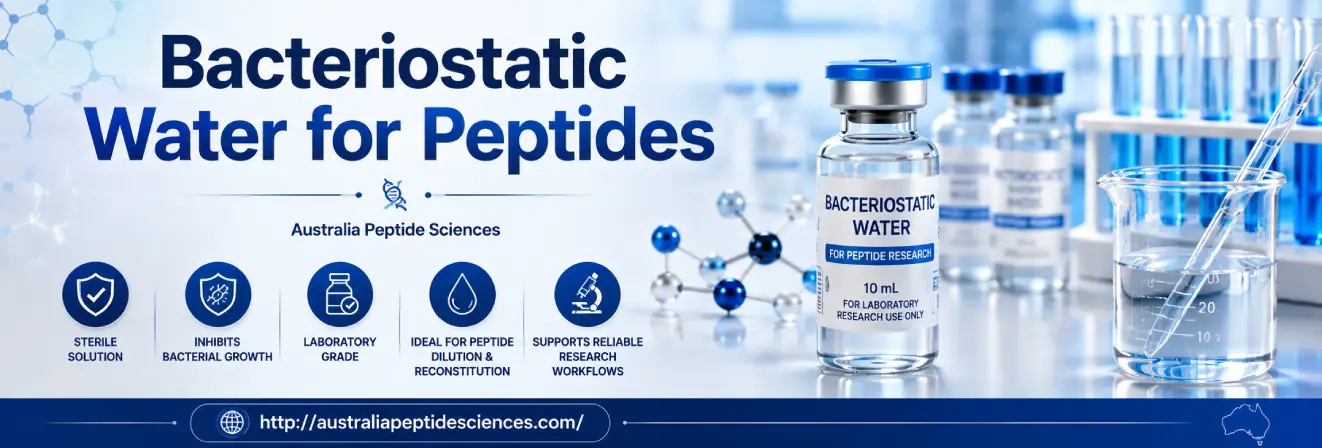
Bacteriostatic water is a laboratory preparation material used in suitable peptide-research workflows involving dilution, reconstitution and controlled solution preparation.
Researchers may use bacteriostatic water during laboratory dilution and reconstitution where compound documentation and experimental requirements establish compatibility. Its benzyl-alcohol preservative helps inhibit bacterial growth but does not by itself establish peptide stability.
This guide explains what bacteriostatic water is, how it works, why researchers use it, how it compares with sterile water, and what to consider when sourcing bacteriostatic water Australia laboratories may use for peptide-related research.
What Is Bacteriostatic Water?
Bacteriostatic water is a sterile aqueous solution containing purified water and a small amount of benzyl alcohol, commonly around 0.9%, which functions as a bacteriostatic preservative.
The primary purpose of this preservative is to help inhibit bacterial growth after the vial has been accessed under controlled laboratory conditions.
Because of this preservative system, bacteriostatic water is often described as a sterile bacteriostatic water solution suitable for controlled research handling and laboratory preparation.
Typical Composition of Bacteriostatic Water
| Component | Purpose |
| Sterile Water | Solvent base |
| Benzyl Alcohol (typically 0.9%) | Helps inhibit bacterial growth |
| Sterile Vial Environment | Supports contamination control |
Bacteriostatic water is usually supplied in sealed laboratory vials and may be available in several formats, including bacteriostatic water 10mL packaging commonly used in laboratory workflows.
The solution itself is:
- Clear
- Colorless
- Sterile
- Laboratory prepared
- Intended for controlled research environments
Because bacterial contamination can interfere with laboratory consistency, solutions containing bacteriostatic preservatives may provide practical advantages in research handling compared with non-preserved alternatives.
How Does Bacteriostatic Water Work?
The defining feature of bacteriostatic water is the inclusion of benzyl alcohol.
Rather than functioning as a sterilizing agent that destroys all microorganisms instantly, benzyl alcohol works by helping inhibit bacterial multiplication under controlled conditions.
This distinction is important.
Many researchers misunderstand bacteriostatic water as simply “sterile water.” While both may begin as sterile preparations, bacteriostatic water includes an antimicrobial preservative that supports multi-access laboratory handling.
The mechanism can be summarized simply:
- Sterile water acts as the liquid solvent
- Benzyl alcohol provides bacteriostatic properties
- Bacterial growth becomes more difficult under appropriate conditions
- Laboratory handling may become more manageable during repeated vial access
This characteristic explains why research bacteriostatic water is commonly discussed in peptide preparation and laboratory dilution workflows.
Bacteriostatic Water for Peptides: Why Is It Used?
Bacteriostatic water for peptides is commonly associated with research preparation workflows involving lyophilized or freeze-dried compounds.
Many research peptides are supplied in dry powder form. Before laboratory investigation can proceed, researchers often prepare solutions under controlled conditions.
This is where peptide reconstitution water becomes relevant.
In laboratory research, peptide reconstitution refers to preparing a dry compound with a compatible solvent for a defined experimental workflow. Solvent selection depends on compound-specific documentation, solubility, stability and protocol requirements.
Bacteriostatic water may be selected for this purpose because it offers several workflow-related advantages.
Relevant laboratory considerations include sterile handling conditions, contamination control, solvent compatibility, reproducibility and consistency with the validated experimental protocol.
The goal is not simply adding liquid to a compound.
Instead, researchers aim to create reproducible laboratory conditions that support consistency throughout peptide investigation.
The broader distinction between experimental peptide materials and other peptide products is explained in What Are Peptides for Research?.
What Is Peptide Reconstitution Water?
The term peptide reconstitution water refers broadly to liquids used to prepare dry peptides into usable laboratory solutions.
Multiple solvent types may be discussed depending on research objectives, compound characteristics, and experimental design.
These may include:
- Sterile water
- Bacteriostatic water
- Buffered solutions
- Specialty laboratory solvents
Choosing among these options depends on factors such as:
- Compound solubility
- Research conditions
- Storage requirements
- Stability considerations
- Laboratory protocol design
Not every peptide requires identical preparation conditions.
This explains why bacteriostatic water research discussions often emphasize understanding compound-specific handling requirements.
Common Research Applications of Bacteriostatic Water
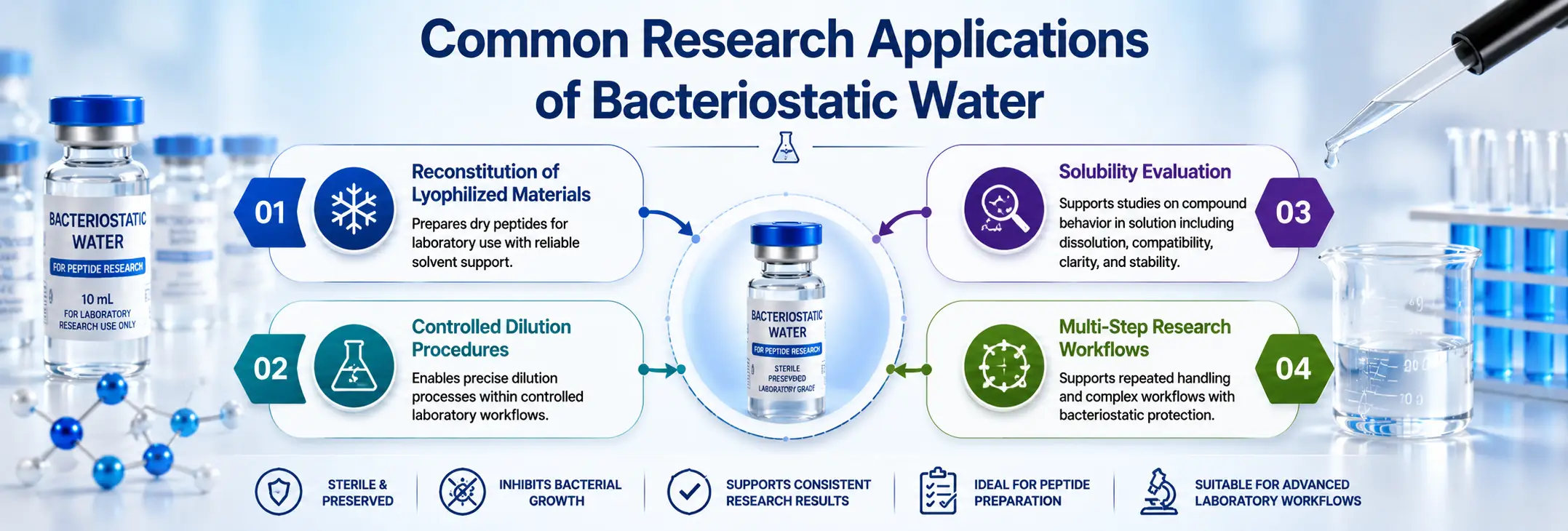
Bacteriostatic water serves multiple laboratory purposes beyond simple dilution.
In peptide-related research, it may support several preparation and analytical workflows.
1. Reconstitution of Lyophilized Materials
Many peptides are stored in dry form to support preservation and transport stability.
Researchers may prepare these materials using carefully selected solvents before laboratory use.
2. Controlled Dilution Procedures
Some laboratory protocols require precise dilution processes.
Bacteriostatic water may be incorporated as part of these controlled workflows.
3. Solubility Evaluation
Researchers often study how compounds behave in solution.
This may involve:
- Dissolution characteristics
- Compatibility assessment
- Solution clarity
- Stability evaluation
4. Multi-Step Research Workflows
In certain environments, repeated handling may occur.
The bacteriostatic preservative system may support these workflows under appropriate laboratory conditions.
Because of these roles, lab grade bacteriostatic water remains a frequently discussed material in peptide laboratories and biochemical preparation environments.
Key Characteristics of Lab Grade Bacteriostatic Water
Not all laboratory water products are identical. Researchers typically evaluate several characteristics before selecting lab grade bacteriostatic water.
Here are most of the important quality factors:
1. Sterility
The solution should be prepared under controlled manufacturing conditions designed to support sterility.
2. Preservative Content
Benzyl alcohol concentration matters because it contributes to bacteriostatic function.
3. Packaging Integrity
Researchers commonly prefer:
- Sealed glass vials
- Controlled packaging
- Tamper-resistant formats
- Clear labeling
4. Manufacturing Standards
Laboratories may review:
- Quality control practices
- Production consistency
- Sterility testing
- Documentation transparency
These considerations often become particularly relevant when sourcing bacteriostatic water online.
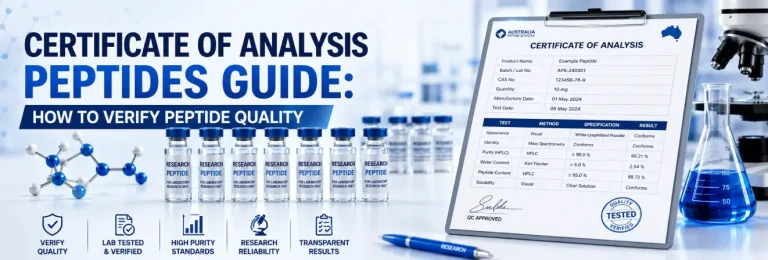
Analytical documentation and batch verification are discussed in the Certificate of Analysis Peptides Guide.
Bacteriostatic Water vs Sterile Water
One of the most common questions in peptide preparation involves comparing bacteriostatic water with ordinary sterile water.
Although these products may appear similar, they differ in several important ways.
| Feature | Bacteriostatic Water | Sterile Water |
| Sterile | Yes | Yes |
| Contains Preservative | Yes | No |
| Benzyl Alcohol | Usually 0.9% | None |
| Bacterial Growth Inhibition | Present | Limited |
| Research Workflow Use | Common | Context dependent |
The largest difference is preservative content.
Sterile water contains no bacteriostatic additive.
Bacteriostatic water contains a preservative system, while sterile water generally does not. A more detailed formulation comparison is available in Sterile Water vs Bacteriostatic Water.
Differences involving saline, ionic composition and preservative content are examined separately in Bacteriostatic Water vs Saline.
This distinction explains why many peptide laboratories specifically seek bacteriostatic water for peptides rather than using non-preserved water solutions.
Laboratory Storage and Handling Considerations
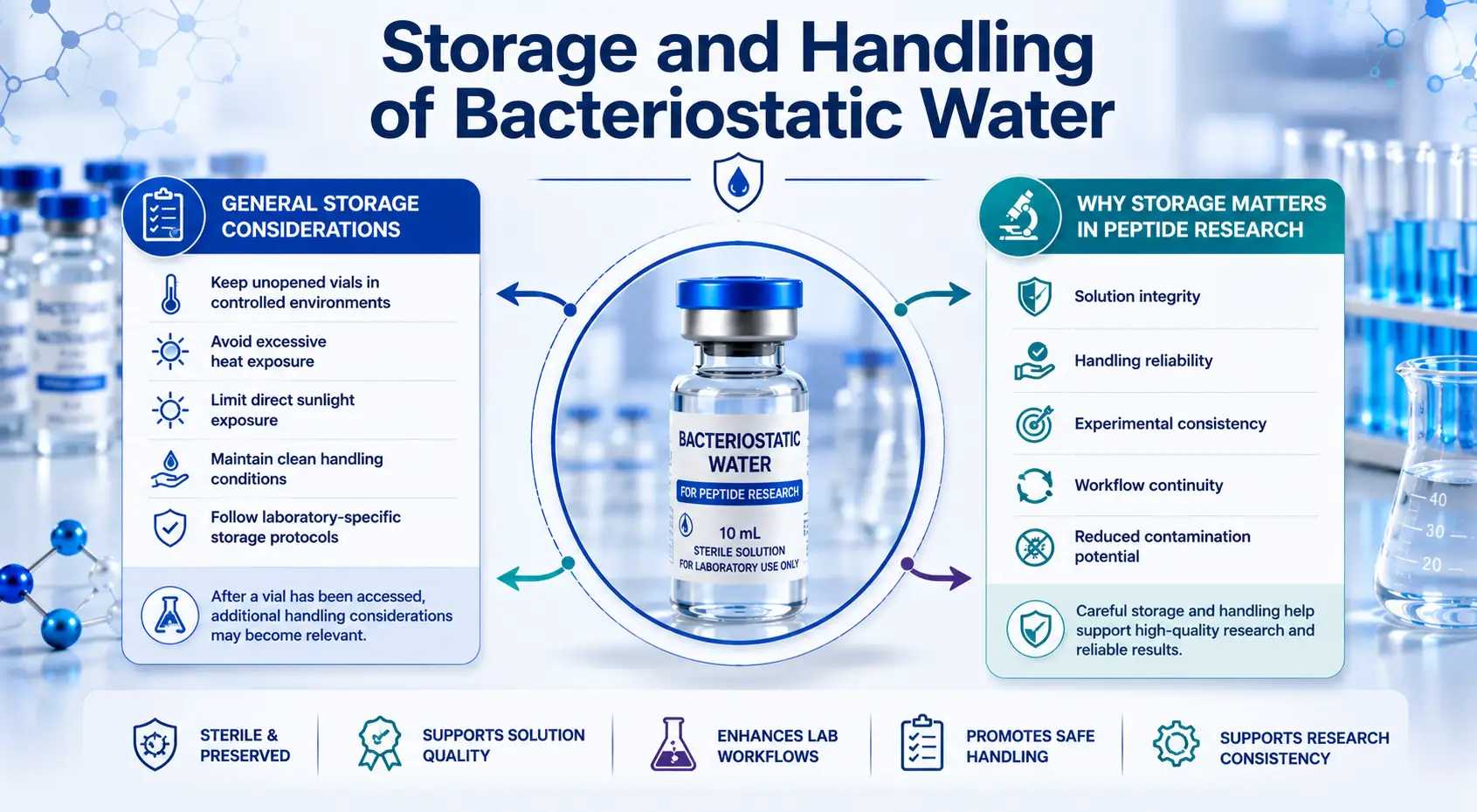
Storage and handling should follow the applicable product documentation and laboratory protocol. Relevant variables may include temperature, light exposure, container integrity, contamination control and compound-specific compatibility after preparation.
After a vial has been accessed, additional handling considerations may become relevant depending on laboratory procedures and internal protocols.
Why Storage Matters in Peptide Research
Storage practices influence several research factors.
These may include:
- Solution integrity
- Handling reliability
- Experimental consistency
- Workflow continuity
- Reduced contamination potential
Even high-quality research bacteriostatic water benefits from careful laboratory handling.
For this reason, researchers often treat solvent handling with the same level of attention applied to peptides and research compounds themselves.
Understanding Bacteriostatic Water 10mL Formats
Many laboratories work with bacteriostatic water 10mL packaging because it offers practical advantages for routine preparation and controlled research use.
The choice of vial size often depends on laboratory workflow requirements.
Some researchers prefer smaller formats for:
- Limited experimental work
- Small batch preparation
- Reduced material waste
- Simplified storage management
Others may select larger formats depending on research volume and operational requirements.
Why 10mL Vials Are Common
A bacteriostatic water 10mL vial may support:
- Convenient laboratory handling
- Compact storage
- Controlled access
- Flexible workflow use
Researchers frequently consider workflow practicality alongside solution quality when selecting laboratory materials.
Packaging Characteristics Researchers Often Prefer
When evaluating packaging, laboratories may prioritize:
- Laboratory-grade glass or another container format appropriate to the stated product specification
- Secure sealing systems
- Clear labeling
- Sterile packaging environments
- Controlled manufacturing standards
Packaging integrity matters because it helps support product consistency during transportation, storage, and laboratory handling.
Evaluating Bacteriostatic Water for Laboratory Research in Australia
As peptide research expands, sourcing reliable laboratory materials has become increasingly important.
Laboratories evaluating bacteriostatic water in Australia may consider formulation transparency, preservative concentration, container integrity, storage information, manufacturing documentation and consistency with the intended research workflow.
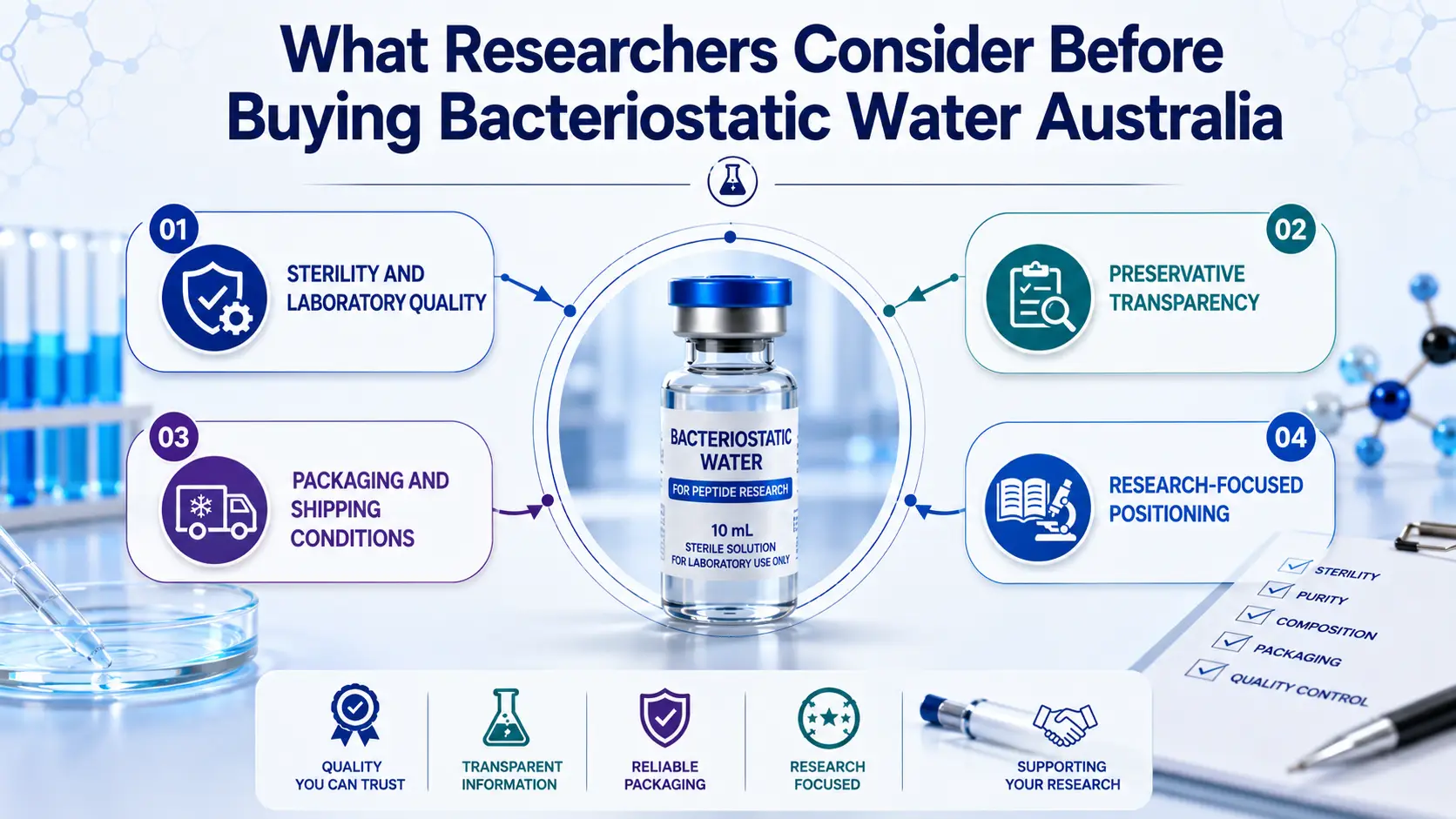
Important Buying Considerations
1. Sterility and Laboratory Quality
The first consideration is typically whether the product is prepared under controlled manufacturing conditions designed to support sterility.
Researchers may review:
- Sterility practices
- Production standards
- Laboratory-grade positioning
- Quality documentation
This is particularly relevant when evaluating lab grade bacteriostatic water.
2. Preservative Transparency
Bacteriostatic function depends on preservative inclusion.
Researchers often prefer products with clearly described composition information.
Typical information may include:
| Product Detail | Why It Matters |
| Water Composition | Product transparency |
| Benzyl Alcohol Content | Bacteriostatic function |
| Vial Volume | Workflow planning |
| Storage Guidance | Handling consistency |
| Manufacturing Information | Quality evaluation |
Transparency helps researchers understand whether a product aligns with laboratory expectations.
3. Packaging and Shipping Conditions
Shipping and storage conditions may influence laboratory materials.
Researchers commonly review:
- Protective packaging
- Temperature considerations
- Sealed vial integrity
- Handling procedures
For laboratories ordering bacteriostatic water online, transportation reliability can become an additional factor.
4. Research-Focused Positioning
Many researchers prefer suppliers focused specifically on laboratory and research materials.
Research-oriented suppliers often provide:
- Educational resources
- Scientific positioning
- Clear research-use labeling
- Product transparency
- Better technical communication
This can help laboratories evaluate whether materials align with their workflow requirements.
Broader laboratory-supplier criteria are discussed in the Where to Buy Research Peptides in Australia guide.
Why Bacteriostatic Water Research Matters
The growing interest in peptides has also increased attention toward solvent selection and preparation quality.
Bacteriostatic water research is not simply about the water itself.
It relates to broader laboratory principles involving:
- Sterility
- Reproducibility
- Handling precision
- Solution preparation
- Workflow standardization
Reliable solvent systems support more controlled experimental environments.
In many laboratories, preparation quality is viewed as part of overall research quality.
This is one reason research bacteriostatic water remains widely discussed within peptide-related scientific workflows.
Laboratory Handling Considerations for Peptide Reconstitution Water
Laboratories frequently establish internal handling procedures to support consistent workflows when using peptide reconstitution water.
Although exact procedures vary depending on research design and compound requirements, several broad principles commonly guide laboratory handling.
General Research Best Practices
Relevant controls may include sterile technique, container integrity, compound-specific compatibility, documented storage conditions and monitoring of visible changes in prepared solutions. Exact procedures depend on the experimental protocol and material documentation.
Researchers generally aim to minimize unnecessary variability during preparation procedures.
Because peptide compounds can differ in stability and behavior, handling practices often remain compound-specific.
This is especially relevant in the growing field of research peptides Australia, where preparation quality and laboratory consistency are important considerations.
Common Misunderstandings About Bacteriostatic Water
Several misconceptions surround bacteriostatic water for peptides.
Clarifying these points helps support better laboratory understanding.
Misconception 1: Bacteriostatic Water Is Just Ordinary Water
This is inaccurate.
Bacteriostatic water contains a preservative system designed to help inhibit bacterial growth.
Its formulation differs from ordinary water and from many sterile solutions.
Misconception 2: All Sterile Water Is Identical
Laboratory water products differ depending on:
- Composition
- Additives
- Intended purpose
- Handling characteristics
- Research application
Understanding these differences helps researchers select appropriate materials.
Misconception 3: Bigger Volume Always Means Better Value
Volume selection depends on workflow.
Some laboratories may benefit from bacteriostatic water 10mL packaging, while others may require alternative sizes.
Selection should match laboratory use patterns rather than volume alone.
Misconception 4: Solvent Selection Does Not Matter
Solvent compatibility can influence:
- Preparation workflow
- Solubility assessment
- Handling conditions
- Solution stability
For this reason, solvent selection is often considered part of broader research planning.
Bacteriostatic Water for Peptides and Laboratory Workflow Efficiency
Laboratory research often depends on repeatability and controlled preparation methods.
This explains why bacteriostatic water for peptides continues to play a practical role in many peptide-related workflows.
Researchers may value bacteriostatic water because it can support:
- Cleaner preparation workflows
- Greater handling convenience
- Reduced contamination concerns
- Controlled laboratory procedures
- Consistent research preparation
These factors contribute to overall laboratory efficiency and workflow management.
Rather than being viewed as merely a solvent, bacteriostatic water is often considered part of the preparation system supporting peptide research.
Bacteriostatic water is a laboratory diluent distinguished by the presence of a bacteriostatic preservative, commonly benzyl alcohol. Its suitability in peptide research depends on formulation compatibility, sterile handling, container integrity, storage conditions and the requirements of the specific experimental protocol. Use of a preserved diluent should not be interpreted as evidence of peptide stability or suitability beyond the defined laboratory workflow.
Bacteriostatic water and peptide materials supplied for research should remain within their stated laboratory purpose. The distinction is covered further in the Research Use Only Peptides guide.
Available laboratory diluent formats can be reviewed in the BAC Water category.
FAQs about Bacteriostatic Water for Peptides
Do peptides need bacteriostatic water?
Not always. Whether peptides require bacteriostatic water depends on the specific compound, laboratory protocol, and research objectives. Many researchers use bacteriostatic water for peptides because it contains benzyl alcohol that helps inhibit bacterial growth during controlled laboratory handling.
Where can Australian laboratories source bacteriostatic water for research?
Laboratory diluent materials can be sourced from research-focused suppliers that provide clear composition, storage and research-use information. Australia Peptide Sciences supplies bacteriostatic water for controlled laboratory research.
Which diluents may be evaluated for peptide research?
Depending on compound compatibility and protocol requirements, research workflows may evaluate bacteriostatic water, sterile water, buffered solutions or other defined laboratory solvents. There is no universal diluent for every peptide.
What is bacteriostatic water for peptides?
Bacteriostatic water for peptides is a sterile laboratory solution containing purified water and a small amount of benzyl alcohol that helps inhibit bacterial growth during controlled research handling and peptide preparation workflows.
Is bacteriostatic water the same as sterile water?
No. While both may begin as sterile preparations, bacteriostatic water contains a preservative system, typically benzyl alcohol, whereas sterile water generally does not.
What does peptide reconstitution water mean in laboratory research?
It refers to a compatible solvent used to prepare a dry peptide for a defined experimental workflow. Selection depends on compound documentation, solubility, stability and protocol requirements.
Sources:
- https://dailymed.nlm.nih.gov/dailymed/lookup.cfm?setid=3a6422e1-feee-4095-8883-2b0837039e6e
- https://dailymed.nlm.nih.gov/dailymed/lookup.cfm?setid=87d6e9dc-fe3b-4593-ac9a-d7493d1959c7
- https://pmc.ncbi.nlm.nih.gov/articles/PMC4830481/
- https://www.bachem.com/knowledge-center/handling-and-storage-guidelines-for-peptides/