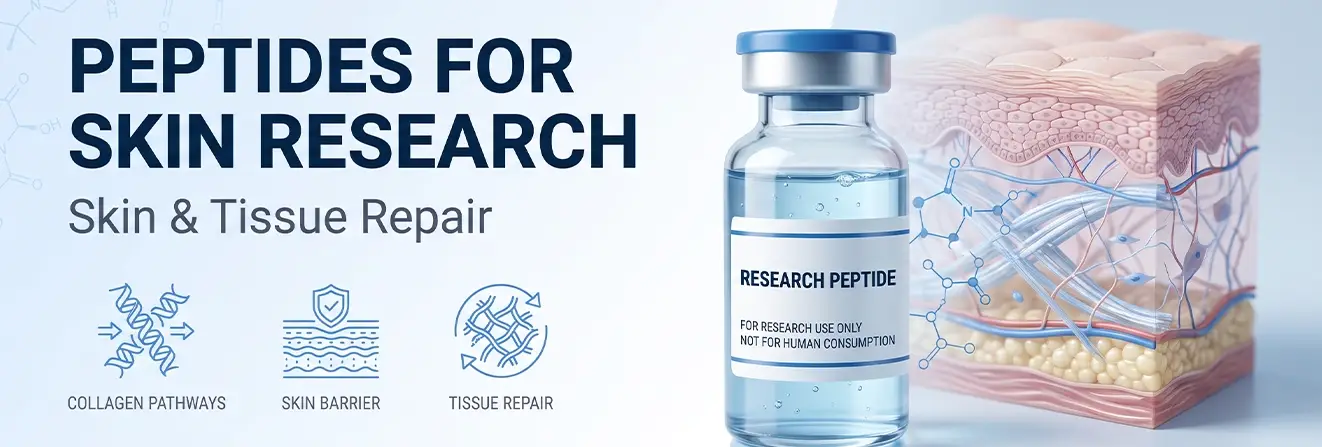
Peptides for skin research are investigated in controlled models of collagen turnover, inflammation, barrier function and tissue repair.
Their activity depends on the peptide sequence, formulation, delivery system and experimental model, so findings from cultured cells cannot be assumed to apply to intact human skin.
Research-use-only compounds are intended for laboratory investigation and not for personal, cosmetic or therapeutic use.
What Are Peptides in Skin Research?
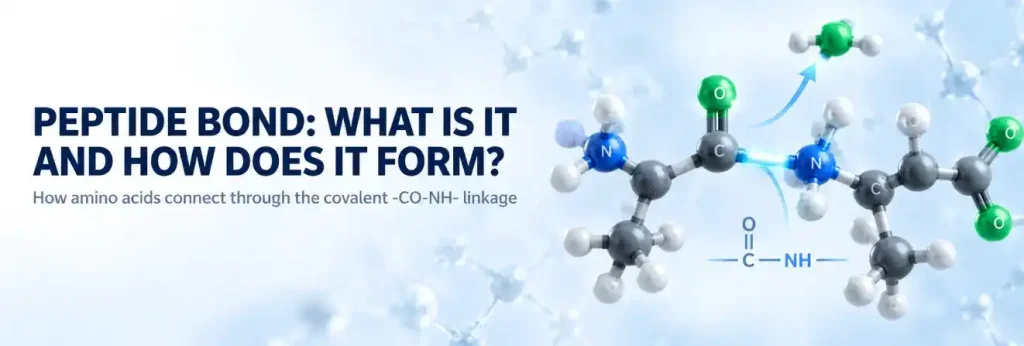
Peptides are short sequences of amino acids joined by peptide bonds. In skin peptide research, they may be isolated from biological systems, produced through protein breakdown, or synthesised with a defined sequence for experimental use.
Their function is determined by more than length alone. Relevant properties include:
- Amino-acid sequence and three-dimensional conformation
- Molecular size, charge and water or lipid solubility
- Resistance to oxidation, hydrolysis and enzymatic degradation
- Binding affinity for a receptor, enzyme, metal ion or matrix component
- Concentration, exposure time and delivery system
- The cell type, tissue model and experimental conditions
Some peptides influence cell signalling, enzyme activity, trace-element transport or immune defence, making them useful in skin research. However, not every peptide supports repair, penetrates the skin or produces proven clinical effects.
Explore GHK-Cu peptide for laboratory studies of copper binding, fibroblast activity and extracellular-matrix remodelling.
Why Skin and Tissue Repair Are Closely Connected
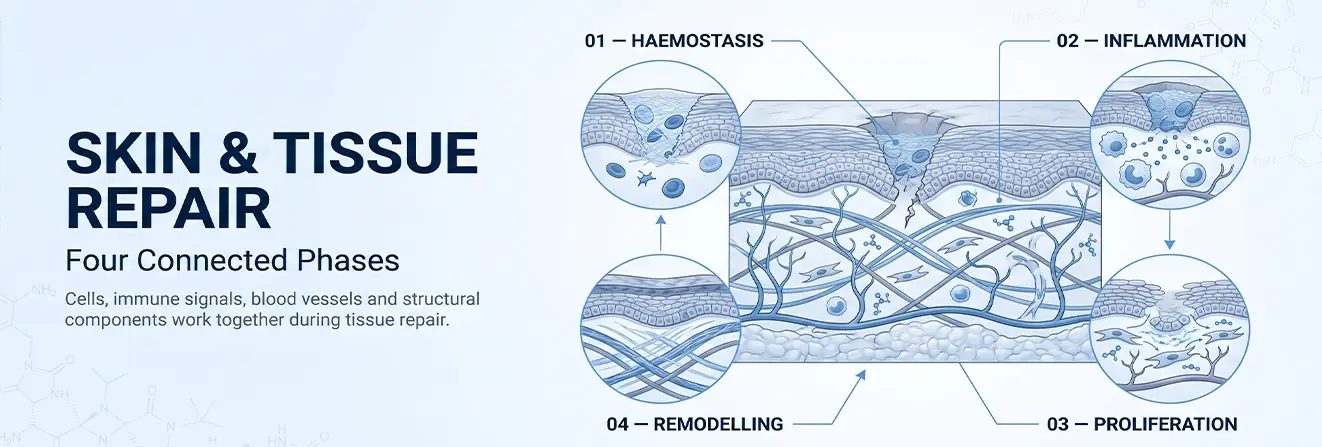
Skin repair depends on coordinated activity between cells, blood vessels, immune signals, and structural components. Because these elements influence one another, researchers often examine several biological responses rather than measuring a single marker.
| Skin component | Role in tissue repair | Common research focus |
| Epidermis | Restores the external barrier | Keratinocyte migration and barrier recovery |
| Dermis | Supports skin structure | Fibroblast activity and collagen production |
| Extracellular matrix | Organises and supports cells | Collagen, elastin and fibronectin remodelling |
| Immune cells | Coordinate inflammation and defence | Cytokine activity and inflammatory responses |
| Vascular system | Delivers oxygen and nutrients | Endothelial activity and new vessel formation |
The Four Phases of Tissue Repair
Although these phases overlap, tissue repair is generally divided into four stages:
- Haemostasis: Blood clotting begins, helping limit blood loss and create a temporary matrix around the injured area.
- Inflammation: Immune cells remove damaged material and release signals that help coordinate the repair response.
- Proliferation: Keratinocytes migrate, fibroblasts produce extracellular matrix, and new blood vessels support developing tissue.
- Remodelling: Temporary matrix components are replaced, while collagen fibres are reorganised to improve tissue structure and strength.
Research into peptides involved in tissue repair may track several connected processes, but changes in cell migration or collagen expression alone do not demonstrate complete healing, restored tissue strength, or human safety.
Browse our full range of research peptides available in Australia, with clear product specifications and batch-specific documentation.
How Are Peptides for Skin Research Studied?
Researchers select a model according to the mechanism they want to test.
Well-designed studies pair a clearly characterised peptide with a predefined biological endpoint and appropriate controls.
Cellular Signalling and Gene Expression
A peptide may bind to a cell-surface receptor or influence a molecular interaction that changes intracellular signalling. Researchers can then measure downstream responses such as gene transcription, protein production, cell migration or enzyme activity.
What Do Researchers Measure in Skin-Related Studies?
- Fibroblast proliferation and migration
- Keratinocyte migration and differentiation
- Growth-factor signalling
- Cytokine production
- Extracellular-matrix gene expression
- Cellular responses to ultraviolet or oxidative stress
Cellular repair peptides are a broad description rather than a single mechanistic class.
Two sequences marketed under that description may act through entirely different targets, and some may have only preliminary laboratory evidence.
Collagen Peptide Pathways and Matrix Remodelling
Collagen provides much of the dermis with its structural strength. Research on oral collagen supplements addresses a different question and should be evaluated separately from studies of isolated peptides in skin models.
However, healthy tissue depends on a controlled balance between collagen production, degradation and reorganisation. For this reason, researchers assess the entire remodelling process rather than measuring collagen synthesis alone.
Common research measurements include:
- Type I and type III collagen gene expression
- Procollagen and mature collagen protein levels
- Fibronectin, elastin and glycosaminoglycan production
- Matrix metalloproteinase activity, including MMP-1 and MMP-2
- Tissue inhibitors of metalloproteinases
- Collagen fibre density, alignment and organisation
GHK-Cu peptide is studied for its effects on collagen synthesis and matrix-remodelling enzymes.
These findings remain specific to the laboratory models, formulations and delivery methods studied.
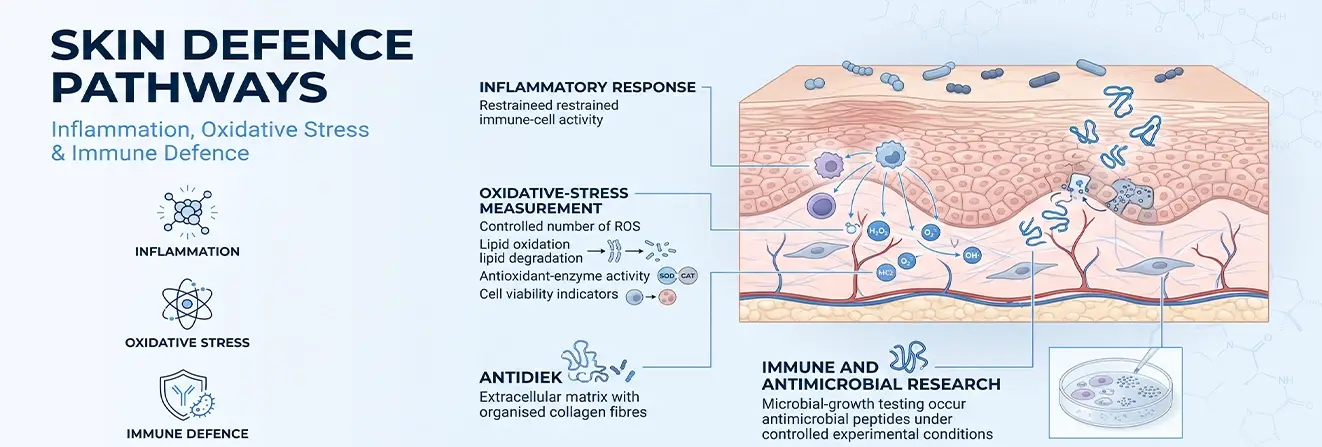
How Are Inflammation, Oxidative Stress and Immune Defence Studied?
Inflammation helps remove damaged material and coordinate early tissue repair, but its duration and resolution are equally important.
Researchers examining oxidative stress may measure reactive oxygen species, lipid oxidation, antioxidant enzymes and cell viability alongside inflammatory and immune responses.
Changes in individual markers, however, do not independently confirm tissue healing.
Antimicrobial peptides may also be studied for their effects on microbial growth, immune signalling and skin-barrier responses.
Reduced microbial activity in vitro does not establish infection control in living tissue, as outcomes depend on concentration, exposure time, toxicity and the experimental environment.
Major Peptide Categories in Skin Biology
In skin research, peptides are more clearly classified by the mechanism being studied than by broad commercial labels.
| Category | Typical research focus | Example endpoints | Key limitation |
| Signal peptides | Cell communication and matrix-related signalling | Gene expression, procollagen, migration | A biomarker change may not produce tissue-level repair |
| Carrier peptides | Binding or transport of ions such as copper | Enzyme activity, fibroblast response, matrix remodelling | Activity depends on metal availability and complex stability |
| Enzyme-modulating peptides | Influence on enzymes involved in matrix turnover or pigmentation | MMP activity, substrate conversion, inhibitor balance | Off-target activity and dose response require testing |
| Antimicrobial peptides | Innate defence and immunomodulation | Minimum inhibitory concentration, cytokines, cell viability | Laboratory antimicrobial activity may require concentrations unsuitable for tissue models |
| Neuropeptide-related compounds | Neural signalling or neurotransmitter-release models | Receptor binding, transmitter release, contraction assays | These outcomes are not equivalent to structural repair |
GHK-Cu may fit multiple categories because it binds copper and is studied for its effects on fibroblast activity and matrix remodelling. However, its classification does not guarantee a specific outcome.
Peptides for Skin Repair Research
Peptides for skin repair research are evaluated using endpoints that reflect different stages of tissue repair, including inflammation, cell migration, re-epithelialisation and matrix remodelling.
1. Early Inflammatory Response
Researchers may assess cytokine release, immune-cell activity, cell viability and the removal of damaged material. BPC-157 peptide is also studied in controlled models involving inflammatory and tissue-repair pathways. However, a change in a single inflammatory marker is not necessarily beneficial, as effective repair depends on both the initiation and timely resolution of inflammation.
2. Proliferation and Re-epithelialisation
Keratinocyte migration contributes to epidermal barrier restoration, while fibroblasts produce components of the extracellular matrix. Researchers investigating related cell-migration and tissue-repair pathways can also review TB-500 peptide. Scratch assays can measure cell migration under controlled conditions, but they do not replicate the structural, vascular or immune complexity of living tissue.
3. Matrix Maturation and Remodelling
Later-stage studies examine collagen organisation, matrix turnover, tissue thickness and mechanical strength. Rapid closure alone does not confirm successful repair, particularly when the newly formed matrix is poorly organised.
Reliable repair peptide research therefore uses multiple complementary endpoints and distinguishes normal tissue remodelling from fibrosis or excessive matrix accumulation.
How Are Peptides Studied in Skin Ageing Research?
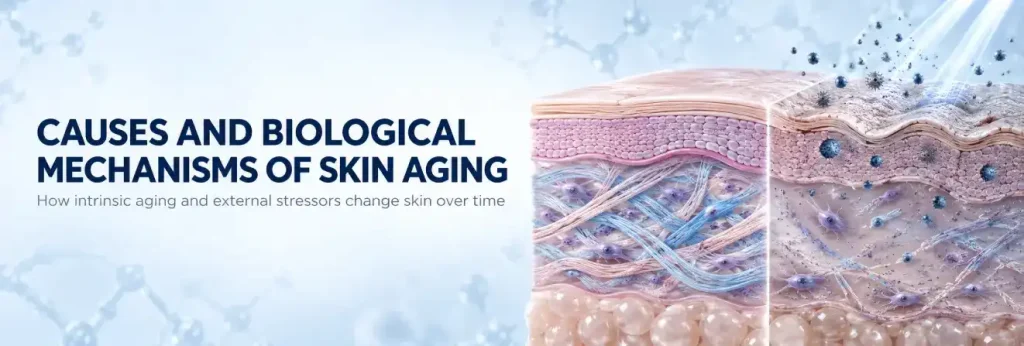
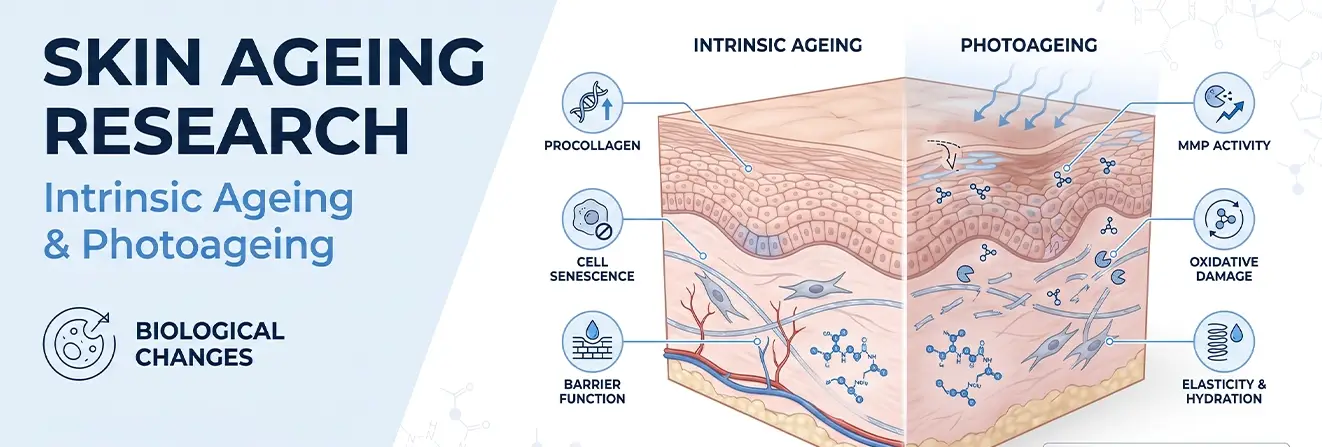
Skin ageing results from intrinsic biological changes and cumulative environmental exposure. Intrinsic ageing affects cell turnover, fibroblast activity and extracellular-matrix maintenance, while photoageing is associated with ultraviolet exposure, oxidative stress and increased matrix degradation.
Studies examining peptides for ageing skin may assess:
- Procollagen expression and collagen organisation
- Matrix metalloproteinase activity
- Fibroblast senescence markers
- Oxidative damage and antioxidant responses
- Epidermal thickness and barrier function
- Elasticity, hydration and skin-surface changes
Human findings apply to the exact formulation, population and study protocol tested.
A 12-week controlled study involving 93 women reported appearance-related improvements with a palmitoyl pentapeptide moisturiser, but the findings cannot be generalised to other peptides, formulations or delivery methods.
Research Models and What Each Can Establish
A robust peptides-for-skin research programme usually progresses from controlled mechanistic work towards more complex models. Each level answers different questions.
| Research model | What it can assess | What it cannot establish alone |
| Biochemical assay | Binding, enzyme inhibition, oxidation or chemical stability | Cellular response or tissue outcome |
| Cell culture | Mechanism, viability, migration and gene or protein expression | Penetration through intact skin or whole-tissue repair |
| Co-culture or 3D skin model | Interactions between cell types and aspects of tissue architecture | Complete systemic and immune responses |
| Ex vivo skin | Permeation, retention and local tissue response | Long-term effects in a living organism |
| Animal model | Integrated repair, inflammation and tissue remodelling | Direct equivalence to human skin biology |
| Controlled human study | Formulation-specific tolerability and measured outcomes | Generalisation beyond the tested product, population and protocol |
Common methods include qPCR, immunoassays, microscopy, histology and barrier-function testing. Reliable studies also require appropriate controls, biological replicates and a pre-specified analysis plan.
How Do Delivery and Stability Affect Skin Penetration?
In skin research, biological activity is meaningful only when the peptide remains stable and reaches the target tissue at a measurable level.
Skin penetration depends on molecular mass, charge, solubility, and formulation, while direct permeation testing remains necessary.
Variables commonly assessed include:
- Lipid conjugation and sequence modifications
- Liposomes, nanoparticles and hydrogels
- Penetration enhancers and controlled-release systems
- Protection from light, moisture, oxygen and enzymes
Delivery systems can alter peptide retention, release and exposure, making complete formulation details and stability measurements essential throughout storage and experimentation.
Indicators of Stronger Research Evidence

1. Material Characterisation
Stronger studies document the peptide sequence, molecular mass, salt or counter-ion form, batch identity, purity data, storage conditions and handling procedures. Identity, purity and peptide content describe different properties and should not be treated as interchangeable.
2. Study Design
A well-controlled design typically includes several concentrations, appropriate vehicle controls, cytotoxicity testing, independent biological replicates and predefined sampling points. Variables such as pH, metal-ion availability and exposure duration may also affect the observed response.
3. Result Interpretation
Results are more informative when effect sizes, uncertainty and negative findings are reported alongside statistical significance. Mechanistic biomarkers should also be distinguished from functional tissue outcomes, with greater weight given to findings that have been independently replicated.
Researchers can review available peptide Certificates of Analysis to assess batch quality. However, a COA does not confirm the compound’s suitability for a specific experiment.
What Are the Common Gaps in Peptide Research Evidence?
Several issues can lead to overstated conclusions:
| Evidence gap | Why it matters |
| Extrapolating from cells to humans | Cell models do not reproduce the complete skin barrier, vascular or immune environment. |
| Generalising from combined formulations | An outcome cannot be attributed to one peptide unless that ingredient is tested separately. |
| Treating collagen production as sufficient | Successful repair also depends on matrix organisation and controlled degradation. |
| Ignoring delivery | Activity measured in vitro does not establish penetration into the target tissue. |
| Confusing purity with potency | Purity does not independently confirm identity, peptide content or biological activity. |
| Using uncontrolled comparisons | Changes may result from natural recovery, vehicle effects or measurement variation. |
| Transferring evidence between peptides | Similar names or categories do not demonstrate equivalent mechanisms or outcomes. |
Peptides for Skin Research in Australia
When selecting peptides for skin research in Australia, researchers can explore BPC peptides while comparing product quality, documentation, and intended use.
Laboratory materials are distinct from cosmetics and approved therapeutic goods, even when they share the same peptide name.
Explore our range of laboratory research peptides in Australia, supported by detailed product information and batch-specific documentation.
Interpreting Peptides for Skin Research
Peptides for skin research are valuable tools for studying cell signalling, collagen turnover, barrier function and tissue repair.
The relevance of a finding depends on the peptide sequence, material quality, delivery system and experimental design. Laboratory results provide mechanistic evidence rather than established human outcomes.
FAQs About peptides for Skin research
Are peptides in skincare scientifically proven?
Some topical peptides have formulation-specific clinical evidence, but this does not prove that every peptide or skincare product is effective.
What is the most effective peptide for skin?
No single peptide is proven to be the most effective, although GHK-Cu and palmitoyl pentapeptides are commonly studied.
Is GHK-Cu peptide available in Australia?
GHK-Cu products may be available, but therapeutic GHK-Cu products are not currently approved by the TGA.
Is there a downside to using peptides?
Possible limitations include skin irritation, poor penetration, formulation instability and limited clinical evidence for some products.
Which is better for ageing skin, peptides or retinol?
Retinol has stronger clinical evidence for photoageing, while peptides may provide gentler, formulation-specific benefits.
Is GHK-Cu serum peptide illegal in Australia?
Not automatically; its legal classification depends on its formulation, intended use and whether cosmetic or therapeutic claims are made.
Can I buy GHK-Cu over the counter?
Cosmetic GHK-Cu serums may be sold retail, but unapproved therapeutic or injectable GHK-Cu is not an ordinary over-the-counter medicine.
What does injecting peptides do to your face?
Facial benefits are not established for unapproved peptide injections, which may cause infection, contamination, or tissue damage.
What is the safest peptide to take?
No peptide is universally safest, and research-use-only peptides should not be taken or self-administered.
Which peptides make you look younger?
No peptide makes someone younger, although some topical peptides have shown modest improvements in wrinkles and skin appearance.
References
ultraviolet radiation and premature skin ageing