

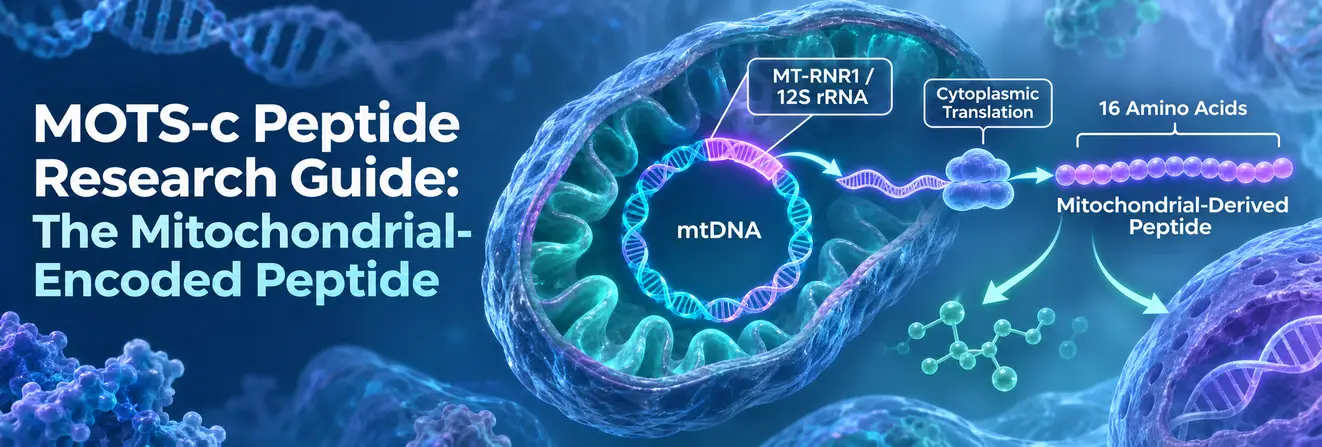
MOTS-c is a 16-amino-acid peptide encoded within mitochondrial DNA (mtDNA). First identified in 2015, it belongs to a group of mitochondrial-derived peptides (MDPs) investigated for their roles in cellular signalling, metabolic regulation and responses to physiological stress.
Unlike most proteins involved in mitochondrial function, which are encoded by nuclear DNA, MOTS-c originates from a short open reading frame within the mitochondrial genome. Research has linked it to AMP-activated protein kinase (AMPK) signalling, glucose metabolism and skeletal muscle function.
Laboratory and animal studies have identified several biological activities associated with MOTS-c. Human investigations have examined its naturally occurring levels, particularly in relation to exercise and ageing. However, these findings do not establish the safety or therapeutic effectiveness of externally administered MOTS-c.
What Is MOTS-c?
MOTS-c stands for mitochondrial open reading frame of the 12S rRNA type-c. It is a mitochondrial-derived peptide encoded by a short open reading frame (sORF) located within the mitochondrial 12S ribosomal RNA gene, also known as MT-RNR1.
The human mitochondrial genome is traditionally recognised as encoding 13 proteins involved in oxidative phosphorylation, alongside 22 transfer RNAs and two ribosomal RNAs. Research into additional short open reading frames has identified peptides with signalling functions beyond these conventional gene products.
Although MOTS-c is encoded in mitochondrial DNA, evidence indicates that its translation occurs in the cytoplasm. This distinction reflects differences between mitochondrial and cytoplasmic genetic codes. The precise mechanisms responsible for exporting its transcript from mitochondria remain incompletely understood.
MOTS-c is part of a wider family of mitochondrial-derived signalling molecules. The distinctions between these compounds and synthetic mitochondrial-targeted peptides are discussed in our mitochondrial peptides guide.
MOTS-c at a Glance
| Property | Detail |
| Full name | Mitochondrial open reading frame of the 12S rRNA type-c |
| Length | 16 amino acids |
| Genetic origin | Mitochondrial DNA, 12S rRNA region (MT-RNR1) |
| Translation | Cytoplasmic translation indicated by experimental evidence |
| Initial discovery | Lee et al., Cell Metabolism, 2015 |
| Main pathway investigated | Folate metabolism, purine biosynthesis and AMPK signalling |
| Major tissue investigated | Skeletal muscle |
| Evidence level | Predominantly preclinical, with human studies of endogenous MOTS-c and emerging clinical investigation |
For more information about our laboratory research materials, visit Australia Peptide Sciences.
How MOTS-c Was Discovered
The discovery of MOTS-c followed earlier research identifying humanin, another peptide encoded by a short open reading frame within mitochondrial DNA.
Researchers subsequently examined the mitochondrial 12S rRNA region for additional sequences capable of producing functional peptides.
In 2015, Lee and colleagues reported a 51-base-pair open reading frame encoding the 16-amino-acid MOTS-c peptide. Their experiments demonstrated that MOTS-c influenced metabolic pathways in cultured cells and affected insulin sensitivity in mice.
The study identified skeletal muscle as a principal tissue associated with its metabolic actions. It also demonstrated that MOTS-c could influence cellular metabolism through mechanisms involving folate metabolism, purine biosynthesis and AMPK activation.
These findings expanded the understanding of mitochondria as signalling organelles capable of influencing cellular and whole-body metabolism, rather than functioning exclusively in energy production.
The original findings were published in Cell Metabolism.
How MOTS-c Works
MOTS-c research has identified two important mechanisms: changes in cellular metabolic signalling and regulation of nuclear gene expression during metabolic stress.
The Folate-Purine-AMPK Pathway
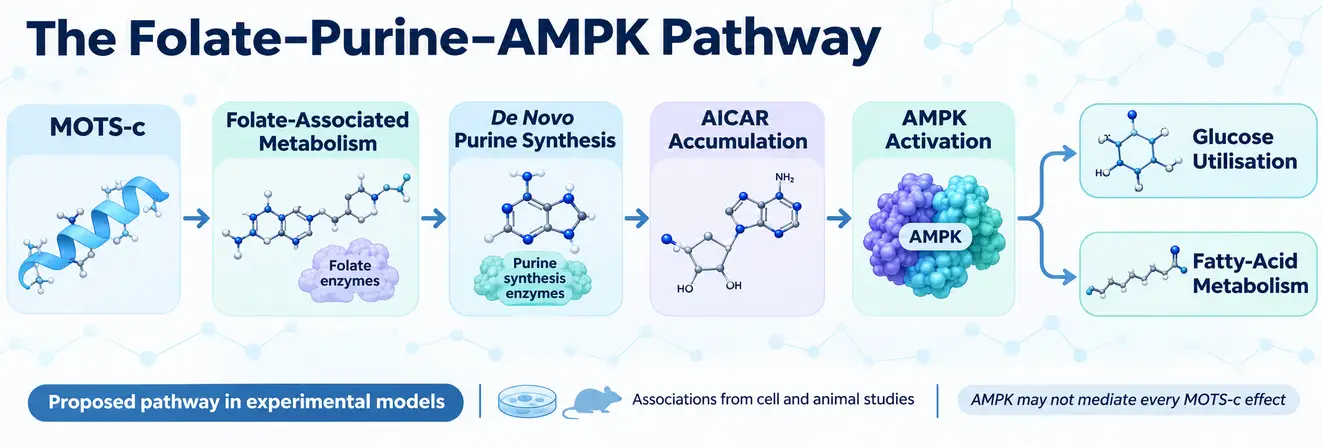
The folate-purine-AMPK pathway is one of the best-characterised mechanisms associated with MOTS-c.
In the original experimental models, MOTS-c altered the folate cycle and its connection to de novo purine biosynthesis. These changes were associated with accumulation of 5-aminoimidazole-4-carboxamide ribonucleotide (AICAR), an intermediate in purine synthesis.
AICAR can activate AMP-activated protein kinase (AMPK), a central regulator of cellular energy balance.
The proposed signalling sequence can be summarised as follows:
- MOTS-c alters folate-associated metabolic pathways.
- Changes in de novo purine synthesis increase intracellular AICAR.
- AICAR contributes to AMPK activation.
- AMPK-associated signalling influences glucose utilisation and fatty acid metabolism.
In the cell models studied, MOTS-c was associated with increased glucose utilisation and changes in fatty acid metabolism. However, the findings do not establish that AMPK mediates every biological effect of the peptide.
AMPK responds to changes in cellular energy availability and helps regulate how cells use available metabolic substrates. NAD+, a metabolic coenzyme rather than a peptide, is also central to cellular redox reactions and mitochondrial energy metabolism.
This relationship is relevant to metabolic flexibility, which describes the capacity of cells and tissues to adjust fuel utilisation according to nutrient supply and energy demands.
Nuclear Signalling and Metabolic Stress
MOTS-c is also investigated for its ability to influence communication between mitochondria and the nucleus.
A 2018 study by Kim and colleagues demonstrated that MOTS-c could relocate to the nucleus during metabolic stress through an AMPK-dependent process.
Once inside the nucleus, MOTS-c interacted with stress-responsive transcription factors, including nuclear factor erythroid 2-related factor 2 (NRF2), and influenced the expression of genes associated with cellular stress responses.
This represents a form of mitochondrial-to-nuclear communication known as retrograde signalling.
Because mitochondrial-derived signals can influence functions beyond the organelle itself, MOTS-c is sometimes discussed as a mitochondrial signalling factor or mitokine. Nevertheless, its complete signalling network, cellular uptake mechanisms and potential extracellular targets remain areas of investigation.
The nuclear signalling findings were reported in Cell Metabolism in 2018.
For a visual explanation of MOTS-c signalling, the following video explores its mitochondrial origin and the molecular pathways investigated in research.
https://youtu.be/hOtzikcVZ4c?si=-m-ee35gku45uWph
What the Research Shows
MOTS-c research has expanded from its original discovery into studies of metabolic regulation, skeletal muscle adaptation, exercise responses and age-associated biological changes.
The strongest functional evidence comes from controlled experiments involving cultured cells and animals.
| Study | Research model | Main findings | Evidence limitation |
| Lee et al., 2015 | Cultured cells and mice | Changes in folate-purine metabolism, AMPK activation and improved measures of insulin sensitivity in mice | Preclinical findings |
| Kim et al., 2018 | Cellular models | AMPK-dependent nuclear translocation and regulation of stress-responsive gene expression | Cellular mechanisms do not establish whole-body clinical effects |
| Reynolds et al., 2021 | Mice, muscle cells and healthy young men | Improved physical performance in mice, cellular stress adaptation and increased endogenous MOTS-c after exercise in humans | Human findings concern naturally produced MOTS-c |
Metabolic Regulation in Cell and Animal Studies
Early research examined how MOTS-c influences glucose metabolism, insulin signalling and cellular energy balance.
In cultured cells, MOTS-c altered glucose utilisation, glycolytic activity and metabolic intermediates associated with purine and fatty acid metabolism.
In mice, Lee and colleagues reported improvements in measures of skeletal muscle insulin sensitivity. Their experiments also found that MOTS-c treatment prevented high-fat-diet-associated weight gain and insulin resistance under the conditions studied.
These observations support further investigation of mitochondrial-derived peptides in metabolic regulation.
However, responses in cell cultures and animal models cannot be assumed to occur in humans. Differences in metabolism, experimental exposure and physiological regulation limit direct translation.
Muscle and Physical Capacity
A 2021 study by Reynolds and colleagues investigated MOTS-c in young, middle-aged and old mice.
The researchers examined animals aged approximately 2, 12 and 22 months and reported improvements in physical performance following MOTS-c treatment in the experimental groups.
A separate experiment initiated intermittent treatment late in the animals’ lives, at approximately 23.5 months. Researchers observed improvements in measures of physical capacity and healthspan, including aspects of movement and muscular function.
The same investigation examined C2C12 muscle cells exposed to metabolic stress. MOTS-c influenced cellular adaptation through mechanisms involving heat shock factor 1 (HSF1), a transcription factor associated with stress responses and protein homeostasis.
These results support a research relationship between MOTS-c, skeletal muscle metabolism and age-associated physical function in experimental models.
They do not demonstrate improvements in human endurance, muscle strength or longevity.
Endogenous MOTS-c in Humans
Human studies have investigated whether naturally produced MOTS-c changes in response to exercise and ageing.
In the 2021 Reynolds study, 10 healthy young men completed a stationary cycling exercise protocol.
Researchers reported that endogenous MOTS-c levels increased approximately 11.9-fold in skeletal muscle after exercise, while circulating levels increased approximately 1.6-fold during exercise and 1.5-fold immediately afterwards.
Circulating levels subsequently returned towards baseline following recovery.
These results indicate that MOTS-c expression can respond to acute exercise. However, the small sample and restricted participant population limit generalisation.
Other investigations have reported differences in circulating and skeletal muscle MOTS-c levels across age groups. These findings suggest that age-related regulation may vary between tissues and experimental conditions.
Importantly, measuring endogenous MOTS-c does not establish what happens when a synthetic form is supplied externally.
Exercise-related mitochondrial adaptations also involve processes such as mitochondrial biogenesis, which coordinates changes in mitochondrial components, gene expression and cellular energy capacity.
MOTS-c vs Humanin and SHLPs
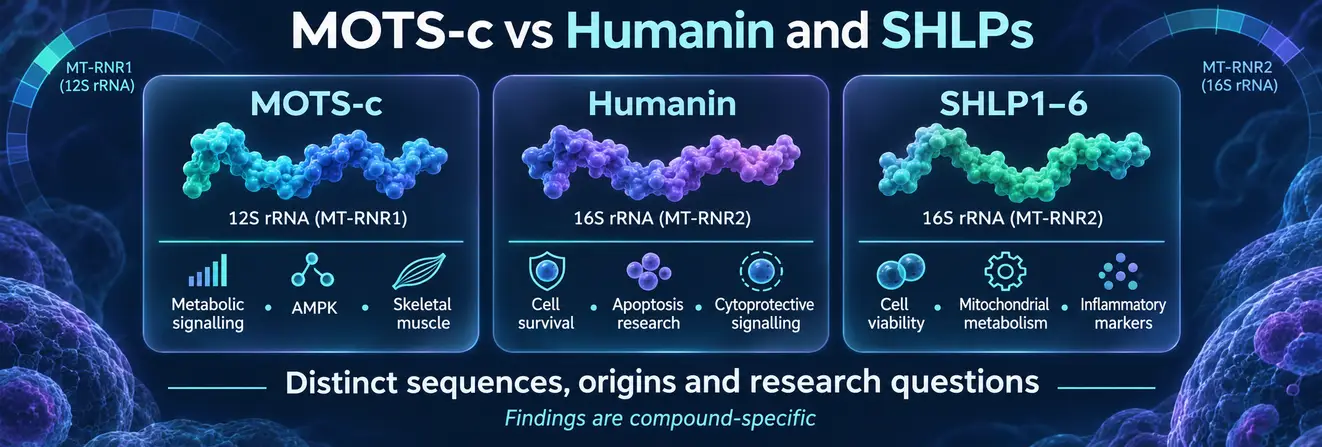
MOTS-c, humanin and small humanin-like peptides (SHLPs) belong to the mitochondrial-derived peptide family, but they have distinct sequences, genetic origins and areas of investigation.
| Peptide | Mitochondrial genetic region | Main research focus |
| MOTS-c | 12S rRNA (MT-RNR1) | Metabolic signalling, AMPK, skeletal muscle and ageing |
| Humanin | 16S rRNA (MT-RNR2) | Cell survival, apoptosis and cytoprotective signalling |
| SHLP1-6 | 16S rRNA (MT-RNR2) | Cell viability, mitochondrial metabolism, inflammatory markers and insulin-related pathways |
Humanin has been investigated extensively in cellular stress and survival models, particularly those involving apoptosis.
SHLPs represent a group of six distinct peptides. Experimental studies have identified differences in their effects on cell viability and metabolic regulation. SHLP2 and SHLP3, for example, have been investigated for their influence on mitochondrial metabolism and cellular stress responses.
These findings do not establish that all mitochondrial-derived peptides share the same biological effects, nor should they be applied directly to synthetic mitochondria-targeting peptides such as SS-31.
Differences in peptide sequence, tissue interactions and signalling mechanisms require compound-specific investigation. Results obtained with humanin or SHLPs should not be attributed to MOTS-c without direct experimental support.
Limits of the Evidence
MOTS-c remains an active area of scientific investigation, and several limitations affect how its findings should be interpreted.
What Preclinical Findings Cannot Establish
Most mechanistic and functional research involving MOTS-c has been conducted in cultured cells or animal models.
The main limitations include:
- Model differences: Cellular and animal responses may not reproduce human physiology.
- Limited human outcomes: Studies of endogenous MOTS-c do not demonstrate the effects of administered peptide.
- Incomplete mechanism: Important questions remain about cellular uptake, signalling targets and tissue-specific activity.
- Long-term uncertainty: Long-term safety and biological effects of externally administered MOTS-c have not been established in humans.
- Ageing research limitations: Improvements in mouse physical performance or healthspan do not demonstrate extended human lifespan.
These distinctions are essential when interpreting studies involving insulin resistance, physical performance or age-associated metabolic changes.
Human Trials and MOTS-c Analogues
Clinical investigation of MOTS-c and related compounds is developing, but the identity of each experimental compound matters.
CB4211, a modified analogue associated with MOTS-c research, underwent a Phase 1a/1b clinical study registered as NCT03998514.
The programme investigated safety, tolerability and other outcomes in healthy volunteers and participants with fatty liver disease. Sponsor-reported findings from this analogue cannot establish the safety or effectiveness of native MOTS-c.
A separate study registered as NCT07505745 is investigating MOTS-c in adults with prediabetes and overweight or obesity. The publicly available registration does not provide completed results establishing clinical efficacy or safety.
Clinical trial registration demonstrates that a compound is under investigation, not that it is safe, effective or approved for therapeutic use.
MOTS-c and Australian Regulatory Considerations
MOTS-c research in Australia must be distinguished from approved therapeutic use.
The Therapeutic Goods Administration (TGA) regulates therapeutic goods, including peptide products, under Australian law. Medicines approved for supply through the relevant regulatory pathway are recorded on the Australian Register of Therapeutic Goods (ARTG).
MOTS-c is not an established TGA-approved medicine for routine human use. Its investigation in laboratory or clinical research does not constitute therapeutic approval.
The TGA also makes clear that labelling a product Research Use Only or Not for Human Use does not automatically exempt it from regulation. Classification and legal obligations depend on the product’s characteristics, intended purpose and relevant circumstances.
Researchers and suppliers must assess applicable requirements concerning importation, manufacture, supply and advertising rather than relying solely on product disclaimers.
Official guidance is available through the TGA’s peptide products information.
Quality Considerations for Researchers
Reliable research using synthetic MOTS-c depends on material identity, analytical characterisation and experimental consistency.
Materials listed as cellular research peptides may differ in sequence, mechanism and analytical specifications, so research findings and quality data should be assessed for each compound.
Sequence Identity, Purity and Certificate of Analysis

MOTS-c consists of 16 amino acids, making correct sequence assembly important when producing synthetic research material.
Peptide synthesis can introduce incomplete sequences, deletion products and other impurities that may influence experimental results.
Two commonly used analytical techniques are:
- Mass spectrometry: Provides molecular mass information that supports evaluation of peptide identity.
- High-performance liquid chromatography (HPLC): Separates components under defined analytical conditions and can provide a measure of chromatographic purity.
These techniques provide complementary information. Neither should be interpreted as a universal guarantee of complete material characterisation.
A reported HPLC purity percentage generally describes the proportion of detected chromatographic signal attributed to the target component under specified conditions. It does not necessarily represent the absolute peptide mass percentage in the entire sample.
Further information about analytical interpretation is available in our peptide purity guide.
A Certificate of Analysis (COA) should identify the material and associated batch, with sufficient information about the tests performed and their results.
Researchers can review the relevant documentation and testing information using our guide on how to read a Certificate of Analysis.
Analytical purity and molecular identity do not, by themselves, establish sterility, biological safety or suitability for administration.
Storage and Experimental Reproducibility
Peptide stability is another consideration when interpreting laboratory results.
Storage conditions may influence chemical integrity through degradation, oxidation, moisture exposure or other processes, depending on the peptide sequence and formulation.
For MOTS-c research, laboratories should assess storage conditions against material-specific stability information rather than assuming that one temperature or storage duration is appropriate for every preparation.
Relevant factors include temperature history, physical state, exposure to moisture and light, and repeated handling.
Changes in material integrity can introduce variation into cellular and biochemical assays, potentially affecting comparisons between experimental groups.
Our peptide storage guide explains the general factors involved in laboratory peptide stability and handling.
Explore our research peptide catalogue to view available laboratory research compounds.
The Current State of MOTS-c Research
MOTS-c has expanded scientific understanding of mitochondrial signalling by demonstrating that the mitochondrial genome can encode peptides involved in metabolic regulation and cellular stress responses.
Research has established important experimental relationships between MOTS-c, the folate-purine-AMPK pathway, nuclear signalling and skeletal muscle metabolism.
Animal studies have identified changes in insulin sensitivity and physical performance, while human investigations have shown that endogenous MOTS-c can respond to exercise.
Nevertheless, the translation of these findings into human therapeutic outcomes remains unresolved. Continued research is needed to clarify compound-specific mechanisms, clinical responses and long-term safety.
Further information about individual research compounds and their evidence is available in our research peptide guides.
For Research Use Only. Not for human or veterinary use.
Explore MOTS-C for laboratory research → View specifications, pricing and Certificates of Analysis.
FAQs About MOTS-c
What is MOTS-c?
MOTS-c is a 16-amino-acid mitochondrial-derived peptide encoded within the 12S rRNA region of mitochondrial DNA. Discovered in 2015, it is studied for its involvement in metabolic regulation, cellular stress responses and skeletal muscle function.
How does MOTS-c work?
MOTS-c influences cellular metabolism through pathways involving folate metabolism, purine synthesis and AMPK activation. Experimental research also shows that it can enter the nucleus during metabolic stress and influence genes involved in cellular adaptation.
What effects of MOTS-c have been observed in research?
Preclinical investigations have associated MOTS-c with improved glucose regulation, insulin sensitivity and physical performance in mice. These findings have encouraged further research into metabolic signalling and age-related muscle function, although equivalent benefits have not been established in humans.
What is the difference between MOTS-c and humanin?
Both are mitochondrial-derived peptides, but they differ in genetic origin and biological activity. MOTS-c is encoded within the 12S rRNA region and is primarily studied for metabolic signalling, whereas humanin originates from the 16S rRNA region and is investigated for its involvement in cell survival and stress protection.
Does exercise affect MOTS-c levels?
Yes. A 2021 study involving 10 healthy young men found increased naturally occurring MOTS-c in skeletal muscle and blood following exercise. The findings suggest a relationship between physical activity and mitochondrial peptide signalling, but do not establish the effects of externally administered MOTS-c.
Has MOTS-c been tested in human clinical trials?
Human research has primarily examined naturally occurring MOTS-c and its associations with physiological processes. Clinical investigations involving MOTS-c or related analogues have been registered, but published controlled evidence has not established the safety or effectiveness of administered native MOTS-c in humans.
Is MOTS-c peptide available in Australia?
MOTS-c is advertised by some Australian suppliers for laboratory research. However, commercial availability does not imply approval for therapeutic use. The Therapeutic Goods Administration (TGA) regulates peptide products according to their intended purpose, and research-use labelling does not automatically remove regulatory obligations.
Does MOTS-c get rid of belly fat?
There is no established evidence that MOTS-c selectively reduces abdominal fat in humans. Although mouse studies have reported reduced weight gain and changes in metabolic regulation under high-fat dietary conditions, these findings do not demonstrate targeted fat reduction or clinically effective weight loss.