Epitalon peptide is a synthetic tetrapeptide studied primarily in cellular-aging, telomere and gene-regulation research.
Published evidence includes in-vitro experiments and animal studies examining telomerase-related activity, cellular senescence, circadian pathways and oxidative-stress markers.
These findings remain experimental and do not establish therapeutic anti-aging, longevity or human lifespan effects.
Research-use note: Australia Peptide Sciences materials are supplied strictly for laboratory and scientific research and are not intended for human or veterinary administration.
What Is Epitalon Peptide?
Epitalon peptide is a synthetic tetrapeptide composed of four amino acids in the sequence Alanine-Glutamic Acid-Aspartic Acid-Glycine (Ala-Glu-Asp-Gly, commonly abbreviated AEDG). Epitalon is a structurally defined synthetic AEDG tetrapeptide associated with peptide sequences investigated within earlier pineal-polypeptide research.
Its defined molecular structure makes it more suitable for controlled analytical and experimental work than heterogeneous biological extracts.
Epitalon vs Epithalon vs Epithalamin Structural and Naming Differences
Researchers frequently encounter inconsistent terminology across the literature. The distinctions matter for anyone conducting Epitalon peptide research, and for a broader introduction to this compound class, see our guide on What Are Peptides for Research?:
| Term | Description |
| Epitalon | Common English transliteration of the synthetic AEDG tetrapeptide |
| Epithalon | Alternative transliteration from the original Cyrillic; chemically identical to Epitalon |
| Epithalamin | The original bovine pineal polypeptide extract from which AEDG was later identified as a genuine structural component |
Published analytical work has reported AEDG-related sequences within pineal peptide preparations, although the historical literature varies in methodology and nomenclature.
Epitalon Research Compound: Origin and Scientific Development
Epitalon emerged from a bioregulator research program that began in the 1970s, built on the premise that specific organs produce short peptide sequences capable of regulating gene expression in a tissue-specific, age-dependent manner. Earlier bioregulator research proposed that short peptide sequences might influence age-related gene-expression patterns. This remains a research hypothesis rather than an established explanation of biological ageing.
Key milestones in Epitalon research compound development include:
- Initial isolation and animal studies using the pineal extract Epithalamin across multiple species, including mice, rats, and primates
- Confirmation through HPLC and mass spectrometry that AEDG exists naturally within the pineal complex
- Transition to synthetic Epitalon as a standardised research tool, enabling controlled dosing and reproducible experimental design
- More recent studies have continued to examine AEDG-related effects in independent cellular models
This progression from a crude biological extract to a defined synthetic compound is what allows modern Epitalon peptide research to apply rigorous, reproducible experimental protocols.
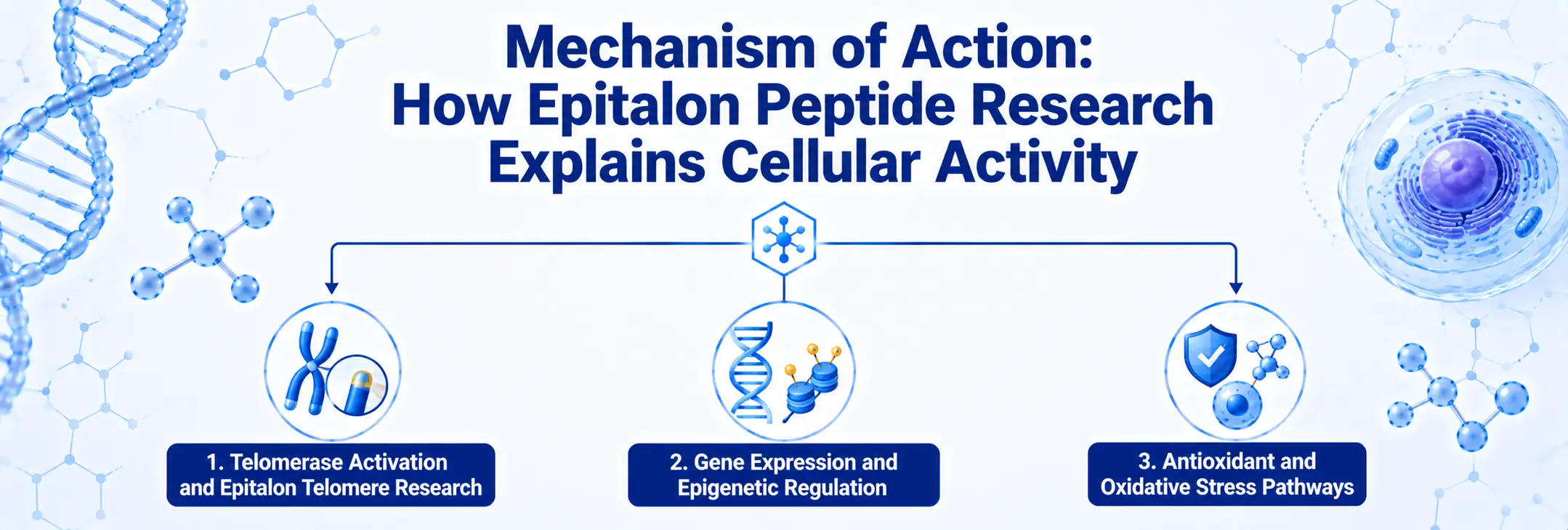
Mechanistic Research: How Epitalon Is Studied at the Cellular Level
Laboratory research into Epitalon has concentrated on several interconnected biological pathways. It is important to note that these mechanisms are described based on in-vitro and animal model findings; extrapolation to human physiological outcomes has not been established through controlled human trials.
1. Telomerase Activation and Epitalon Telomere Research
The central hypothesis driving Epitalon telomere research is that the peptide may influence telomerase, the enzyme responsible for maintaining the protective caps at the ends of chromosomes known as telomeres. Telomeres generally shorten across repeated cell divisions, although telomere dynamics vary by cell type and biological context.
In cultured human cell models, Epitalon has been reported to:
- Induce expression of the catalytic telomerase subunit (hTERT) in telomerase-negative fibroblast cultures
- Restore measurable telomerase enzymatic activity under laboratory conditions
- Extend the number of cell divisions observed before senescence in certain fibroblast lines
2. Gene Expression and Epigenetic Regulation
Beyond telomerase, Epitalon research has explored its potential influence on broader gene expression patterns associated with cellular stress, differentiation and regulatory pathways. These effects are described in the literature as epigenetic modulation, meaning changes in how genes are expressed rather than changes to the underlying DNA sequence.
3. Antioxidant and Oxidative Stress Pathways
Epitalon-related studies have also examined markers associated with oxidative stress and antioxidant defence, including:
- Superoxide dismutase (SOD) activity
- Catalase and glutathione peroxidase expression
- Reduction of lipid peroxidation markers in laboratory models
These pathways are relevant because oxidative stress accumulation is considered a fundamental contributor to cellular ageing across multiple experimental models.
For broader mechanistic context, see our What Is Oxidative Stress? guide.
Epitalon Longevity Research in Animal Models
Animal studies represent much of the evidence behind Epitalon longevity claims. Reported outcomes vary substantially by species, sex, experimental conditions and study design.
| Study Population | Reported Outcome | Key Variable |
| Female rats, standard lighting | No significant lifespan change | Standard light cycle |
| Female rats, natural light cycle | Maximum lifespan extended by approximately 95 days | Natural Northwest-Russian light exposure |
| Female rats, constant illumination | Maximum lifespan extended by approximately 24 days | Constant light exposure |
| Male rats | No extension in mean lifespan; normalised population ageing rate | Same lighting protocols as the female cohort |
| Female CBA mice | Reported slower ageing markers and reduced tumour incidence | Subcutaneous administration from six months of age |
This table illustrates a critical point for anyone relying on Epitalon longevity research: outcomes reported in animal models are consistently dependent on experimental variables such as lighting conditions, sex, and species, rather than representing a single, uniform longevity effect. No completed, independently replicated human trial has measured lifespan or mortality outcomes directly attributable to synthetic Epitalon administration.
Epitalon Cellular Aging and Telomere Research: What the Evidence Actually Shows
1. Original In-Vitro Telomerase Studies
The foundational Epitalon telomere research originates from early 2000s laboratory studies in which Epitalon was applied to telomerase-negative human fetal fibroblast cultures. Researchers reported induction of hTERT expression, restored telomerase enzymatic activity, and telomere elongation. These studies were conducted by a single research laboratory and, for many years, lacked independent replication outside that group.
2. More Recent Telomere and Cellular Studies
More recent studies have examined Epitalon-related telomerase and telomere endpoints in additional cellular models. These findings add to the experimental literature but do not establish effects in living humans.
3. Evidence Boundaries: What This Research Does Not Establish
Responsible interpretation of Epitalon research requires acknowledging clear limitations:
- Telomerase activation observed in cell culture does not confirm that Epitalon activates telomerase in living human tissue
- Fibroblast telomere elongation in a laboratory dish does not predict organism-level lifespan outcomes
- No placebo-controlled human trial has measured telomere length before and after Epitalon exposure
- Claims describing Epitalon as activating telomerase “in humans” or extending lifespan “in people” exceed what current published evidence supports
Comparing Epitalon to Other Research Peptides
| Compound | Primary Research Focus | Distinguishing Mechanism |
| Epitalon | Cellular ageing, telomere biology | Telomerase activation, epigenetic regulation |
| Thymosin Alpha-1 | Immune system modulation | Immune signalling and immunomodulatory research |
| Semax | Neuroprotection | Neurotrophic and neurological research pathways |
| BPC-157 | Tissue repair | Preclinical tissue-response and gastrointestinal models |
Epitalon occupies a distinct research niche because its literature focuses more heavily on telomere biology, cellular ageing and related regulatory pathways.
For comparison, Semax is studied mainly in neurotrophic and neurological models, while BPC-157 is investigated primarily in preclinical gastrointestinal, vascular and tissue-response research.
What Is Known About Epitalon Safety in Preclinical Research?
Available animal studies have reported limited adverse findings under the specific experimental conditions tested, but the evidence base is insufficient to establish a comprehensive safety profile.
However, significant data gaps remain:
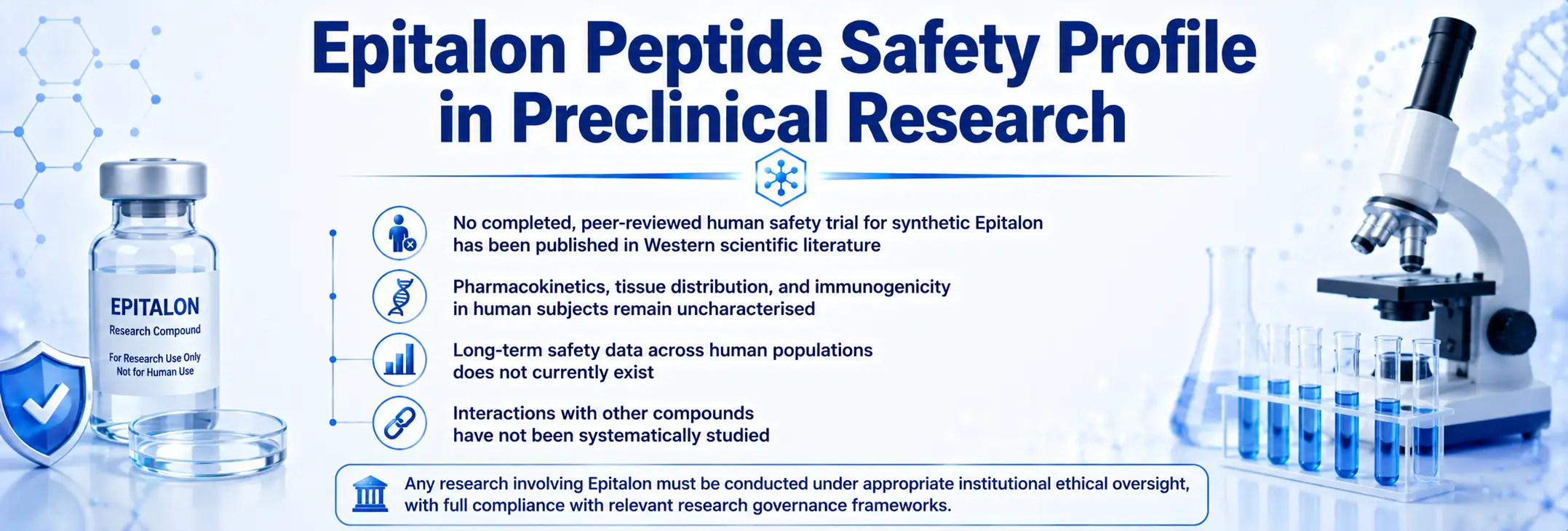
- No completed, peer-reviewed human safety trial for synthetic Epitalon has been published in Western scientific literature
- Pharmacokinetics, tissue distribution, and immunogenicity in human subjects remain uncharacterised
- Long-term safety data across human populations does not currently exist
- Interactions with other compounds have not been systematically studied
Research involving biological systems or human participants must follow the applicable institutional, ethical and regulatory requirements for that study design.
Epitalon in Australia: Research and Regulatory Context
Understanding the regulatory framework for peptides in Australia is essential before handling these compounds.
Key regulatory points for Epitalon Australia compliance:
- A therapeutic Epitalon product should not be represented as TGA-approved unless the exact product is included in the ARTG or is supplied through a valid regulatory pathway. Peptide products regulated as therapeutic goods generally need ARTG inclusion unless an exemption, approval or authority applies.
- Australia Peptide Sciences supplies its Epitalon material strictly for laboratory research rather than therapeutic use.
- Regulatory obligations depend on the product, intended use, claims, ARTG status and applicable exemptions or authorities.
- Any research involving human subjects must comply with Research Ethics Committee approval and applicable Good Clinical Practice standards
- Marketing a peptide as treating, preventing or modifying a physiological condition can bring it within therapeutic-goods regulation, regardless of a “research use only” label.
Researchers and institutions should treat Epitalon strictly as a laboratory reagent, ensuring internal documentation, handling protocols, and communications consistently reflect its research-only status.
The TGA has intensified compliance activity around unapproved peptide products during 2026 and warns that unapproved therapeutic goods have not undergone its standard assessment for safety, quality or effectiveness.
How Should Researchers Evaluate Epitalon Research Materials?
Material identity and analytical documentation can directly affect experimental reliability. Researchers should therefore evaluate Epitalon materials using batch-specific, research-focused criteria.
1. Certificate of Analysis and Purity Verification
- Request a batch-specific Certificate of Analysis (CoA) for every purchase, not a generic product-level document
- Confirm that the analytical method, result and tested batch are clearly stated rather than relying on an unexplained purity percentage
- Consider whether third-party laboratory verification is available alongside internal supplier testing
See our Certificate of Analysis guide and Peptide Purity Explained.
View Certificates of Analysis for Research Materials →
2. Storage and Experimental Preparation Considerations
Peptide stability depends on sequence, formulation, moisture, temperature, light, packaging and time. No universal storage temperature, shelf life, solvent or post-preparation stability period should be applied to every Epitalon material.
Researchers should rely on product-specific stability information, validated study procedures and documented preparation conditions.
For broader laboratory principles, see our Peptide Storage Stability guide and Peptide Reconstitution Guide.
3. Research Material Documentation Checklist
Before using an Epitalon research material, verify:
- Business registration details, including Australian Business Number (ABN) where applicable
- Batch traceability and chain-of-custody documentation
- Relevant quality-management or laboratory accreditation information where applicable
- Clear, consistent “for research use only” labelling across all product materials and communications
Final Notes for Researchers
Epitalon remains an experimental tetrapeptide studied primarily in telomere biology, telomerase-related cellular models, gene regulation, oxidative stress and cellular ageing.
The strongest mechanistic findings remain largely in-vitro or preclinical, while evidence for human longevity, anti-ageing effects or long-term safety is insufficient.
Reliable laboratory interpretation therefore depends on clear compound identity, batch-specific analytical documentation, controlled experimental design and careful separation between mechanistic findings and therapeutic claims.
For additional compound-specific information, browse our Research Peptide Guides.
Explore Epitalon Peptide for Laboratory Research Only →
FAQs about epitalon peptide
What does the peptide Epitalon do?
Epitalon is a synthetic AEDG tetrapeptide studied in cellular models involving telomerase activity, telomere biology, gene regulation and cellular ageing. These findings do not establish equivalent effects in living humans.
Does Epitalon Research Establish Anti-Aging Effects in Humans?
No. Experimental findings involving telomeres or cellular-ageing markers do not establish visible anti-aging or longevity effects in humans.
Has Epitalon Been Studied in Neurological or Pineal-Related Models?
Some preclinical research has examined pineal, circadian and oxidative-stress-related pathways, but robust human neurological outcome data are lacking.
Does Epitalon reduce inflammation?
Some experimental studies have examined inflammatory and oxidative-stress markers, but current evidence is insufficient to establish an anti-inflammatory effect in humans.
How safe is Epitalon?
A complete Epitalon safety profile has not been established. Available evidence is largely preclinical, and robust long-term human safety data are lacking.
Is Epitalon telomere research conclusive?
No. Cell-culture studies have reported telomerase- and telomere-related effects, but these findings do not establish telomere extension or lifespan effects in living humans.
What is the current state of Epitalon longevity research?
The evidence is mainly preclinical and animal-based, with reported outcomes varying by model, sex, species and experimental conditions.
How Is Epitalon Regulated in Australia?
Regulatory status depends on the exact product, intended use, claims and ARTG status. A therapeutic product generally requires ARTG inclusion unless a valid exemption, approval or authority applies. Australia Peptide Sciences supplies Epitalon only as a laboratory research material.
How is Epitalon different from Epithalamin?
Epitalon is a synthetic, defined tetrapeptide, while Epithalamin is the original, less standardised pineal extract.
Is There a Universal Epitalon Research Protocol?
No. Published studies use different experimental models, concentrations, formulations and exposure conditions. Researchers should follow validated study-specific protocols rather than applying a universal administration schedule.
How do researchers measure Epitalon’s effects?
Researchers may use telomerase activity assays, telomere-length measurements, gene-expression analysis, oxidative-stress markers and other model-specific endpoints.
Is Epitalon the Same as Epithalon?
Epitalon and Epithalon are generally alternative transliterations referring to the same AEDG tetrapeptide.
Does Telomerase Activation Mean Longer Lifespan?
No. Telomerase activity observed in cultured cells does not directly predict organism-level lifespan or human longevity.