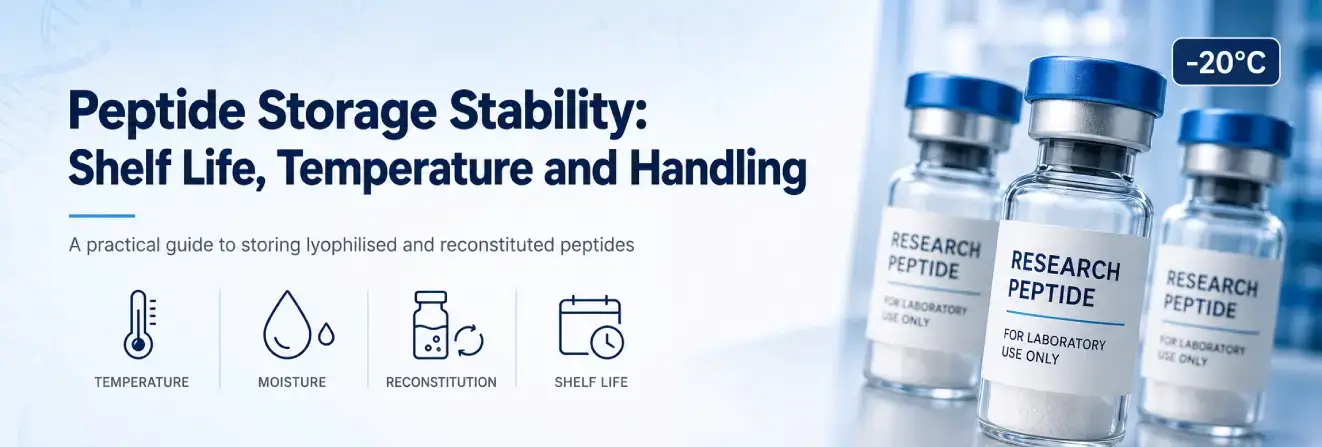
Peptide storage stability depends on the peptide’s physical form, amino acid sequence, formulation, packaging and exposure to temperature, moisture, oxygen and light.
There is no single storage temperature or shelf life that applies to every peptide. Lyophilised peptides are generally more stable than reconstituted solutions, but dry material can still deteriorate when exposed to humidity, repeated temperature changes, oxygen or unsuitable handling.
Correct peptide storage therefore involves more than placing a vial in a refrigerator or freezer. It requires suitable containers, controlled temperature, protection from moisture and light, careful vial opening, clear labelling and limited freeze–thaw cycles.
The information below concerns laboratory storage and handling only. Products supplied solely for research use are not intended for human administration or therapeutic use. Any animal research must follow applicable institutional ethics and regulatory requirements.
What Is Peptide Storage Stability?
Peptide storage stability describes how well a peptide retains its chemical identity, purity, physical condition, concentration and expected research properties while it is stored.
A peptide does not need to show visible damage to become less reliable. Chemical changes may occur even when a powder appears unchanged or a solution remains clear.
The main characteristics that storage practices aim to preserve include:
- Chemical structure
- Purity
- Solubility
- Concentration
- Physical appearance
- Resistance to contamination
- Consistency between uses
A storage problem may result in chemical degradation, physical instability or loss of usable material. These outcomes are related but are not identical.
Chemical Stability
Chemical stability concerns changes to the peptide molecule itself.
Possible changes include oxidation, hydrolysis, deamidation and sequence rearrangement. These reactions can alter the peptide’s identity or reduce its suitability for the intended research application.
Physical Stability
Physical stability concerns changes such as aggregation, precipitation, gel formation or adsorption to the storage container.
A peptide may remain chemically intact but become difficult to use because it has precipitated or attached to the vial surface.
Microbial Control
Microbial contamination is mainly a concern after a peptide has been reconstituted into a liquid.
A solution may retain its original chemical structure while becoming unsuitable because it was prepared, stored or handled under inappropriate conditions. Chemical stability and microbial control should therefore be assessed separately.
What Affects Peptide Storage Stability?
Peptide stability is influenced by several factors that can interact with each other.
Temperature is important, but it should not be considered in isolation. Moisture, oxygen, light, pH, concentration, peptide sequence and the number of handling events can all affect long-term stability.
| Factor | Possible Effect | Higher-Risk Conditions | Practical Control |
| Temperature | Changes the rate of degradation reactions | Heat and repeated fluctuations | Follow product-specific storage instructions |
| Moisture | Encourages hydrolysis and affects dry material | Opening a cold vial in humid air | Warm the sealed vial before opening |
| Oxygen | Promotes oxidation | Repeated opening and large vial headspace | Keep containers tightly closed |
| Light | Can cause photochemical changes | Bright or direct light | Store in suitable light-protective conditions |
| pH | Influences oxidation, hydrolysis and deamidation | Strongly acidic or alkaline conditions | Use an appropriate validated formulation |
| Freeze–thaw cycles | May increase degradation or aggregation | Repeatedly thawing the same stock | Prepare practical aliquots |
| Container surface | May reduce available concentration | Highly dilute solutions | Use compatible low-binding containers |
| Microbial exposure | May affect prepared solutions | Repeated access or unsuitable preparation | Apply appropriate clean handling procedures |
Peptide Form
The peptide’s physical form is one of the most important factors affecting shelf life.
Lyophilisation removes most of the water from a peptide preparation, although residual moisture may remain and can influence long-term stability. This generally reduces hydrolysis, microbial growth and several other processes that occur more readily in solution.
Reconstitution introduces additional stability variables because water, pH, dissolved oxygen, buffer components and container interactions can promote chemical or physical changes. The actual storage period remains peptide- and formulation-specific and should be determined from validated stability information rather than a universal storage estimate.
Diluted working solutions may also be more vulnerable to adsorption because a greater proportion of the peptide can attach to the container surface.
Researchers comparing dry and prepared peptide forms can also review our guide to lyophilised peptides for more information on freeze-dried research materials and their stability characteristics.
Amino Acid Sequence
Each peptide has a different sequence, and each sequence has a different stability profile.
Some residues are more susceptible to oxidation, while others may undergo deamidation, hydrolysis or rearrangement under particular conditions.
The presence of a sensitive amino acid does not automatically mean that the peptide will degrade rapidly. Stability also depends on the surrounding residues, formulation, pH, temperature, oxygen exposure and storage duration.
Moisture and Humidity
Moisture is a major concern in lyophilised peptide storage.
Opening a cold vial immediately after removing it from a freezer may allow water from the surrounding air to condense inside the container. This can introduce moisture into the dry material and reduce its long-term stability.
The vial should normally remain sealed while it reaches room temperature. It should be opened only after it has equilibrated, unless the product documentation specifies a different procedure.
Oxygen Exposure
Oxygen can promote the oxidation of susceptible amino acids.
Repeatedly opening a vial introduces fresh air. A partially empty container may also contain more oxygen relative to the amount of peptide remaining inside.
Keeping the vial tightly sealed and limiting unnecessary access can reduce this exposure.
Light Exposure
Light can contribute to photochemical degradation in some peptides.
Bright light and direct sunlight should generally be avoided. Light-sensitive materials may require amber containers or secondary protective packaging, depending on the product instructions.
Solvent, Buffer and pH
The choice of bacteriostatic water for peptide research or another compatible laboratory solvent or buffer can affect both solubility and stability.
No single solvent is suitable for every peptide. The appropriate choice depends on factors such as:
- Net charge
- Hydrophobicity
- Amino acid composition
- Required concentration
- Buffer compatibility
- Intended research method
- Container material
Strongly acidic or alkaline conditions can increase the rate of certain degradation pathways. The selected pH should therefore support both solubility and stability.
For a broader comparison of commonly discussed preparation media, researchers can also review bacteriostatic water vs saline and sterile water vs bacteriostatic water.
Concentration and Container Material
Peptides in solution may adsorb to glass, plastic, filters, pipette tips and other surfaces.
This can reduce the amount of peptide available in the solution, particularly at low concentrations.
The storage container should be selected according to:
- Chemical compatibility
- Solvent compatibility
- Closure quality
- Storage temperature
- Peptide concentration
- Surface-binding risk
- Required vial size
- Need for light protection
A container suitable for one peptide or solvent may not be appropriate for another.
Lyophilised Peptide Storage Versus Reconstituted Peptide Stability
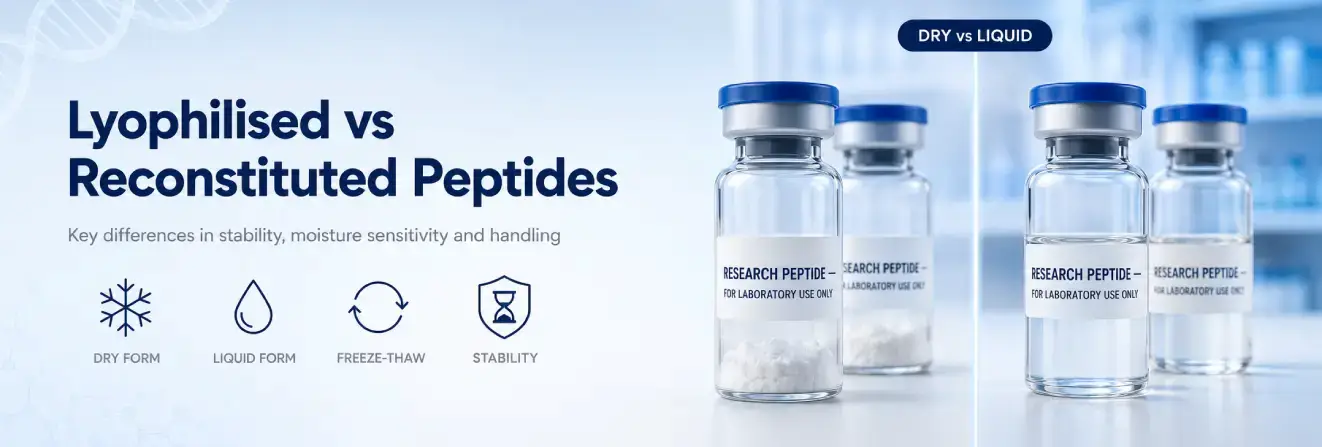
Lyophilised peptides are generally more stable than reconstituted solutions because removing water slows many chemical and microbial processes.
This does not mean that dry peptides remain stable indefinitely. They can still be affected by heat, oxygen, light, residual moisture and repeated handling.
| Characteristic | Lyophilised Peptide | Reconstituted Peptide |
| General stability | Usually higher | Usually lower |
| Water-related degradation | Reduced while dry | More relevant |
| Microbial risk | Lower while sealed and dry | Higher if handling is unsuitable |
| Main environmental concern | Moisture entering after opening | Temperature, pH, oxygen and contamination |
| Freeze–thaw concern | Temperature cycling may still matter | Repeated cycles may be more damaging |
| Typical handling approach | Keep sealed, dry, cold and protected from light | Aliquot, label and store under suitable conditions |
| Shelf-life estimate | Product-specific | Product- and formulation-specific |
Why Lyophilised Peptides Are Usually More Stable
Lyophilisation removes most of the water from the peptide preparation.
Reduced water activity can help limit:
- Hydrolysis
- Microbial growth
- Molecular movement
- Some aggregation processes
- Certain formulation-related reactions
The advantages of lyophilisation can be reduced if the vial is poorly sealed, repeatedly opened or exposed to humid air.
Why Reconstituted Peptides Are More Vulnerable
Reconstitution places the peptide into a liquid environment where several additional risks become relevant.
These include:
- Hydrolysis
- Oxidation
- Deamidation
- Aggregation
- Precipitation
- Surface adsorption
- Microbial contamination
- pH-related instability
Reconstituted peptide stability therefore depends on more than temperature. The solvent, buffer, concentration, container and handling history all influence the usable storage period.
For laboratory preparation principles, see our peptide reconstitution guide, which covers research-focused solvent selection, concentration calculations and preparation considerations.
Peptide Storage Temperature Explained
The correct peptide storage temperature depends on the peptide’s form, sequence, formulation, packaging and validated product information. Researchers should prioritise compound-specific documentation over general temperature recommendations.
Frozen storage is common for many research peptides, but it should not be treated as a universal requirement for every product.
| Storage Condition | Possible Use | Main Limitations | Handling Priority |
| Room temperature | Brief handling or temporary exposure | Faster degradation may occur | Minimise time, light and moisture exposure |
| Refrigerated storage | Short-term or product-specific storage | Degradation continues and condensation may occur | Keep sealed and monitor temperature |
| –20°C storage | Common for many dry peptides and frozen aliquots | Freeze–thaw cycles and freezer fluctuations | Use stable storage and suitable aliquots |
| –80°C storage | Long-term or sensitive research materials | Requires compatible packaging and controlled access | Follow validated procedures |
Room-Temperature Handling
Room temperature is generally more suitable for brief handling than for long-term peptide storage.
A sealed lyophilised vial may tolerate temporary room-temperature exposure better than a prepared solution, but the acceptable duration cannot be assumed without product-specific data.
During handling:
- Keep the vial closed whenever possible.
- Protect it from direct light.
- Avoid humid environments.
- Keep it away from heat sources.
- Return it to the specified storage condition promptly.
- Record any unusual or extended exposure.
Shipping conditions should not automatically be treated as permanent storage instructions. A product may tolerate controlled transport conditions while still requiring colder storage after delivery.
Refrigerated Storage
Refrigeration slows many degradation processes but does not stop them.
It may be appropriate for certain dry products, short-term storage or specific validated solutions. It is not automatically suitable for every reconstituted peptide.
Repeated removal from the refrigerator can expose the vial to temperature changes, condensation and oxygen. A stable refrigerator temperature and secure closure are important.
Storage at –20°C
Storage at approximately −20°C is used for some lyophilised peptides and validated frozen aliquots. It should not be applied to a peptide solution unless the formulation, container, and freeze–thaw behaviour have been assessed.
Its effectiveness depends on:
Stable freezer temperature
Suitable packaging
Tight vial closure
Protection from moisture
- Limited access
- Minimal freeze–thaw exposure
Frost-free freezers may undergo automatic defrost cycles that cause repeated temperature changes. A freezer that maintains a more consistent temperature may be preferable for sensitive materials.
Storage at –80°C
Ultra-low-temperature storage may be appropriate for long-term projects, archival samples or sensitive peptide formulations.
Lower temperatures can slow many degradation reactions, but colder storage is not automatically better in every situation. The container, cap and packaging must remain suitable at the selected temperature.
Frequent removal from an ultra-low freezer can also expose samples to temperature cycling. Storage arrangements should minimise unnecessary access.
How to Store Lyophilised Peptides Correctly
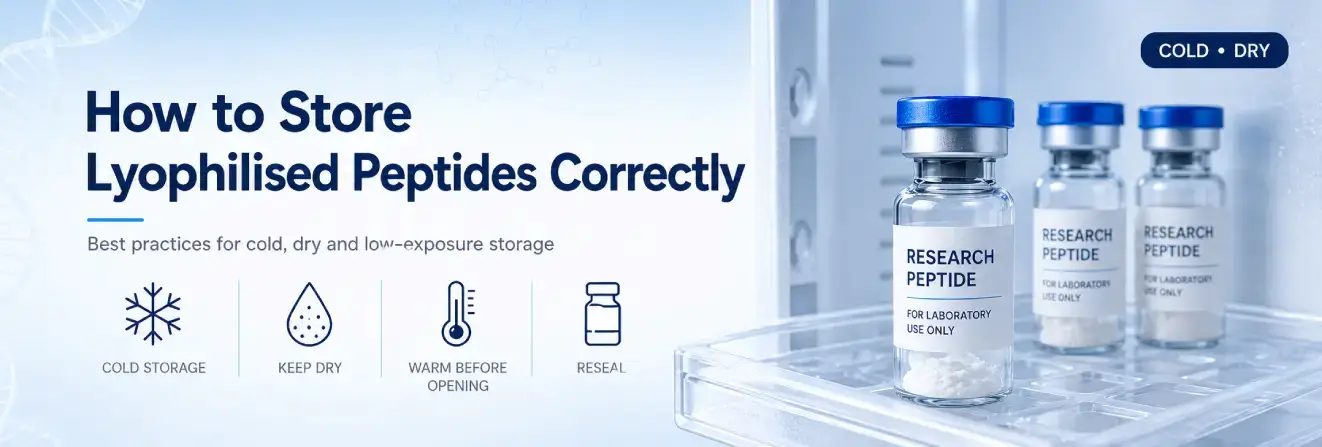
Effective lyophilised peptide storage focuses on keeping research material dry, sealed, protected from unnecessary exposure and stored according to product-specific conditions. For example, researchers working with GHK-Cu can review its individual storage and handling documentation rather than relying only on general peptide guidance.
- Review the product-specific storage instructions.
- Inspect the vial and packaging when received.
- Record the product name, batch number and receipt date.
- Transfer the sealed vial to the specified storage condition.
- Remove it only when material is required.
- Allow the sealed vial to reach room temperature.
- Open it only after equilibration.
- Remove the required quantity efficiently.
- Reseal the vial immediately.
- Return the remaining material to controlled storage.
- Record the opening and handling event.
Why a Sealed Vial Should Warm Before Opening
A cold container can cause atmospheric moisture to condense on its surfaces.
When the vial remains sealed during warming, the surrounding air cannot directly contact the peptide. Opening the vial after it has reached room temperature reduces the risk of condensation entering the dry material.
The vial should not be left open while it is warming.
Managing Repeated Vial Access
Repeated vial access may expose the peptide to:
- Moisture
- Oxygen
- Temperature fluctuations
- Contamination
- Handling errors
Dividing dry material into separate containers may reduce repeated opening of the original stock when suitable equipment and procedures are available.
Dry aliquoting must be performed carefully because transferring powder can also create weighing errors, contamination risks and material loss.
Labelling and Documentation
A peptide storage record should include:
- Product name
- Batch or lot number
- Date received
- Date opened
- Storage temperature
- Container type
- Number of handling events
- Temperature excursions
- Relevant review or expiry date
Complete records make it easier to identify whether a change in performance is related to storage, handling or another part of the research process.
Explore GHK-Cu Peptide for Laboratory Research Only
Batch-specific analytical documentation can provide additional context when reviewing research material quality. See our Certificate of Analysis guide for peptides for an explanation of batch numbers, purity results and analytical documentation.
How to Handle Reconstituted Peptide Solutions
Peptide reconstitution generally introduces additional stability variables because the peptide is transferred from a dry state into a liquid environment where solvent composition, pH, oxygen exposure and container interactions become more relevant.
Prepared solutions should be handled according to product-specific information and an appropriate research procedure.
Select an Appropriate Solvent or Buffer
No universal reconstitution medium, including bacteriostatic water, is suitable for every research peptide. Solvent selection should be based on peptide-specific physicochemical properties, experimental requirements and validated laboratory procedures.
Solubility and stability may depend on:
- Peptide charge
- Hydrophobicity
- Amino acid sequence
- Target concentration
- Buffer pH
- Ionic strength
- Research application
- Container compatibility
Cloudiness, suspended particles or gel formation may indicate incomplete dissolution rather than chemical degradation.
An acidic preparation medium may be appropriate for specific research applications, but its suitability depends on peptide sequence, solubility, concentration and experimental requirements. Researchers should not assume that an acidic solvent is compatible with every peptide.
Divide the Solution Into Aliquots
Aliquoting helps reduce repeated freeze–thaw cycles.
Each aliquot should contain a practical quantity for one use or a defined period of work.
Aliquot planning should consider:
- Required volume
- Concentration
- Number of planned uses
- Container size
- Expected storage period
- Surface adsorption
- Whether an aliquot will be thawed once or repeatedly
Very small aliquots may increase surface contact and handling complexity. One oversized stock may require repeated thawing. Aliquot volume should reflect actual use.
Minimise Microbial Contamination
Prepared solutions are more vulnerable to contamination than sealed lyophilised material.
Appropriate controls may include:
- Clean working conditions
- Suitable sterile equipment where required
- An appropriate research solvent or buffer selected for the peptide and experimental protocol
- Limited vial access
- Secure closures
- Clear labelling
- Avoidance of unnecessary transfers
Filtration may be suitable for some solutions, but it should not be used automatically. Filters can cause adsorption losses and may not be compatible with every peptide or solvent.
Label Every Prepared Solution
Each reconstituted stock or aliquot should state:
- Peptide name
- Batch number
- Concentration
- Solvent or buffer
- Preparation date
- Storage temperature
- Aliquot volume
- Responsible person or initials
- Review or disposal date
An unlabelled solution cannot be evaluated reliably even when the peptide appears unchanged.
Explore Bacteriostatic Water for Laboratory Research
How Long Is Peptide Shelf Life?
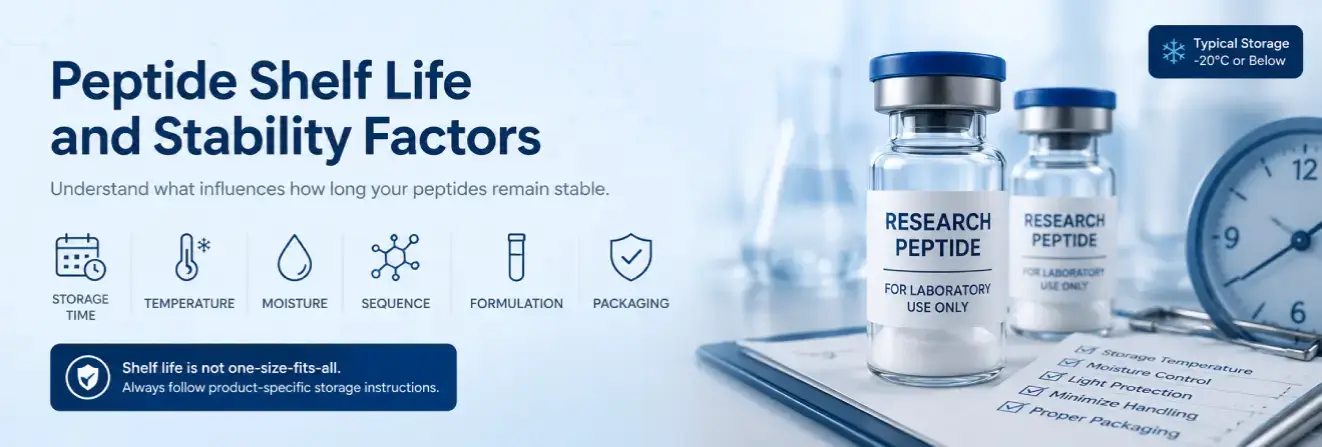
There is no universal peptide shelf life. A reliable shelf-life estimate requires information specific to the peptide, formulation, packaging and validated storage condition. Researchers should avoid applying shelf-life claims from one peptide, formulation or storage environment to another.
What Determines Peptide Shelf Life?
Relevant variables include:
- Amino acid sequence
- Purity and impurity profile
- Counter-ion form
- Residual moisture
- Formulation components
- Container closure
- Oxygen exposure
- Light exposure
- Storage temperature
- Temperature fluctuations
- Solvent and buffer
- Concentration
- Reconstitution date
- Number of freeze–thaw cycles
Shelf-life information applies only to the conditions under which it was established.
Data for a sealed lyophilised vial cannot automatically be applied after the vial has been opened or the peptide has been reconstituted.
Which Shelf-Life Information Should Take Priority?
Use the following order when assessing storage duration:
- Product-specific stability data
- Labelled storage and expiry information
- Batch-specific documentation
- Supplier handling instructions
- Internal validation under the actual research conditions
- General peptide storage guidance
- Informal or anecdotal claims
Claims that all peptides remain stable for the same number of days, months or years should be treated cautiously.
Researchers evaluating batch quality alongside storage history can also review our peptide purity guide and Certificates of Analysis for additional analytical context.
Sequence-Related Peptide Stability Risks
Certain amino acids are associated with recognised degradation pathways, although the full sequence and formulation remain important.
| Residue or Feature | Potential Concern | Conditions That May Increase Risk |
| Cysteine | Oxidation and disulfide changes | Oxygen and elevated pH |
| Methionine | Oxidation | Air, light and oxidising conditions |
| Tryptophan | Oxidative or photochemical changes | Light and oxygen |
| Asparagine | Deamidation | Solution storage and unsuitable pH |
| Glutamine | Deamidation or sequence rearrangement | Extended storage in solution |
| Aspartic acid sequences | Hydrolysis or rearrangement | Certain pH and temperature conditions |
| Highly hydrophobic sequences | Aggregation or poor solubility | Inappropriate solvent or dilution |
| Hygroscopic peptides | Moisture uptake | Opening cold vials in humid air |
Oxidation
Oxidation can alter sensitive amino acid side chains and affect peptide structure.
Risk may increase with:
- Repeated exposure to air
- Bright light
- Elevated pH
- Reactive impurities
- Large vial headspace
- Unsuitable solvents
Because degradation behaviour is closely related to amino acid composition and sequence, researchers may also find our peptide sequence guide useful for understanding how peptide structure is organised.
Hydrolysis and Deamidation
Hydrolysis involves reactions with water and can affect peptide bonds or sensitive side chains.
Deamidation may alter residues such as asparagine or glutamine. Its rate depends on sequence, pH, temperature and time in solution.
These processes are among the reasons why reconstituted peptide stability is usually more limited than stability in the dry state.
Aggregation, Precipitation and Adsorption
Aggregation occurs when peptide molecules associate with each other.
Precipitation occurs when the peptide is no longer sufficiently soluble under the selected conditions.
Adsorption occurs when peptide molecules attach to the vial or equipment surface.
These events have different causes, but each can reduce the amount of peptide available for use.
How to Recognise Possible Peptide Instability
Visible changes may indicate a problem, but appearance alone cannot confirm peptide stability.
Potential warning signs include:
- Unexpected colour change
- Cloudiness
- New precipitation
- Persistent particles
- Gel formation
- Moisture inside a dry vial
- Damaged seals
- Unusual changes in solubility
- Unexplained inconsistency between uses
A clear solution may still contain degradation products. A cloudy solution may reflect incomplete dissolution rather than chemical breakdown.
Reliable confirmation may require appropriate analytical methods, such as chromatography, mass spectrometry, concentration analysis or another validated assay suitable for the research objective. Visual inspection alone cannot establish peptide identity, purity or chemical stability.
The chosen method should be capable of detecting the type of change that matters for the intended research.
For further context on analytical quality, see Peptide Purity Explained.
What to Do After a Temperature Excursion
A temperature excursion occurs when a peptide is exposed to conditions outside its specified storage range.
Examples include:
- Delayed shipment
- Freezer malfunction
- Power outage
- Freezer door left open
- Accidental thawing
- Extended room-temperature exposure
- Incorrect transfer to refrigerated storage
Record the following information:
- Estimated maximum temperature
- Duration of exposure
- Whether the peptide was dry or in solution
- Whether the vial remained sealed
- Previous storage history
- Number of earlier excursions
- Visible changes
- Product-specific storage limits
A peptide should not automatically be considered stable or unusable based on temperature alone.
The excursion should be compared with validated product-specific information and documented laboratory acceptance criteria. Questionable research material should be separated from routine stock until its suitability for the intended experimental application has been assessed.
Visual appearance alone is not sufficient to approve continued use.
Common Peptide Storage Mistakes
Avoid the following practices:
- Opening a vial immediately after removing it from cold storage
- Allowing moisture to enter lyophilised material
- Repeatedly opening the original stock vial
- Leaving peptides exposed to bright light
- Storing prepared solutions without complete labels
- Repeatedly freezing and thawing the same solution
- Using incompatible containers
- Assuming all peptides have the same shelf life
- Treating shipping conditions as permanent storage instructions
- Ignoring freezer temperature fluctuations
- Using an unsuitable solvent without checking compatibility
- Relying only on colour or clarity
- Failing to record the reconstitution date
- Applying general advice instead of product-specific instructions
Practical Research Peptide Storage Checklist
When the Peptide Arrives
- Confirm the product identity.
- Inspect the vial and closure.
- Check the batch number.
- Review the required peptide storage temperature.
- Record the receipt date.
- Transfer the product to the specified storage condition.
Before Opening a Cold Vial
- Prepare the required equipment.
- Keep the vial sealed.
- Allow it to reach room temperature.
- Prepare suitable labels and containers.
- Limit the time outside controlled storage.
After Opening or Reconstitution
- Remove only the required amount.
- Reseal the original vial.
- Prepare practical aliquots where appropriate.
- Label every container completely.
- Record the preparation date.
- Return the material to the specified storage condition.
- Avoid unnecessary future thawing.
Peptide storage stability is determined by the combined effects of physical form, amino acid sequence, temperature, moisture, oxygen, light, formulation, packaging and handling history.
Lyophilised peptides are generally more stable than reconstituted solutions, but no single storage temperature or shelf-life estimate applies to every research peptide. Product-specific documentation, batch information and validated stability data should therefore take priority over general storage claims.
Careful vial handling, controlled storage, suitable aliquoting, complete labelling and accurate documentation can reduce avoidable degradation and support more reproducible laboratory research.
For broader laboratory handling and research information, browse our Research Peptide Guides. Products supplied for research use only must remain within their intended laboratory and analytical context and are not intended for human or veterinary administration.
FAQs about peptide storage stability:
What is the best temperature for peptide storage?
The best temperature depends on the peptide’s physical form, sequence, formulation, packaging and product-specific stability data. Frozen storage is commonly used for many lyophilised research peptides and validated aliquots, but no single temperature should be applied universally.
How long do lyophilised peptides last?
Lyophilised peptides generally remain more stable than peptide solutions because most water has been removed. The actual shelf life depends on the sequence, formulation, residual moisture, packaging, temperature and handling history, so product-specific stability data should take priority over general estimates.
How long are reconstituted peptides stable?
Reconstituted peptide stability depends on the solvent or buffer, pH, concentration, sequence, storage temperature, container, contamination control and freeze–thaw history. A universal number of days should not be assigned without peptide- and formulation-specific stability information.
Are lyophilised peptides more stable than reconstituted peptides?
Generally, yes. Removing water reduces hydrolysis, microbial growth and molecular movement. Lyophilised material can still degrade through oxidation, moisture exposure, heat, light or repeated handling.
Can peptides be stored at room temperature?
Room temperature may be suitable for brief handling or validated temporary transport. It is generally not preferred for long-term peptide storage unless the product documentation specifically supports it.
Should peptides be stored in the refrigerator or freezer?
The correct choice depends on the product. Refrigeration may suit certain short-term conditions, while freezer storage is common for many dry peptides and solution aliquots. Product-specific instructions should take priority.
Why should a peptide vial warm before opening?
Allowing the sealed vial to reach room temperature reduces the risk of condensation forming inside it. Opening a cold vial can introduce atmospheric moisture and reduce the stability of lyophilised material.
Can a peptide be refrozen after thawing?
Repeated freeze–thaw cycles should generally be minimised because they may increase chemical or physical instability in some peptide preparations. Where validated by the research protocol, appropriately sized aliquots can reduce repeated thawing of the same stock.
Does light affect peptide stability?
Light can contribute to photochemical degradation in sensitive peptides. Storage away from bright or direct light is a common precaution unless product-specific information states otherwise.
How can peptide degradation be identified?
Colour changes, cloudiness, precipitation, gel formation or unusual solubility may indicate a problem. However, visual inspection cannot confirm chemical stability. Suitable analytical testing may be required.
What should be done if a peptide becomes warm during shipping?
Record the estimated temperature, duration of exposure, physical form of the material and condition of the vial. Compare the excursion with product-specific transport or stability data before determining whether the research material remains suitable for the intended laboratory application.
Does every peptide have the same shelf life?
No. Peptide shelf life varies according to sequence, formulation, packaging, temperature, moisture, oxygen exposure and handling history. General shelf-life estimates should not replace product-specific evidence.
Sources:
Australian regulatory principles for establishing storage conditions and shelf life are outlined in the TGA guidance on stability testing for prescription medicines.
International principles for stability studies involving proteins and polypeptides are described in the ICH Q5C stability testing guidance for biotechnological and biological products.
General principles covering the effects of temperature, humidity and light are provided in the FDA Q1A(R2) stability testing guidance.
Broader international requirements for storage conditions and shelf-life evaluation are available in the WHO guidelines on stability testing of active pharmaceutical ingredients and finished pharmaceutical products.
Principles for controlled storage, temperature monitoring and the protection of product quality are covered in the WHO good storage and distribution practices for medical products.
Considerations for evaluating stability after a product is opened or prepared are addressed in the TGA guidance on in-use stability testing.
Q1 Stability Testing of Drug Substances and Drug Products
ICH Q5C Stability testing of biotechnological/biological products – Scientific guideline