
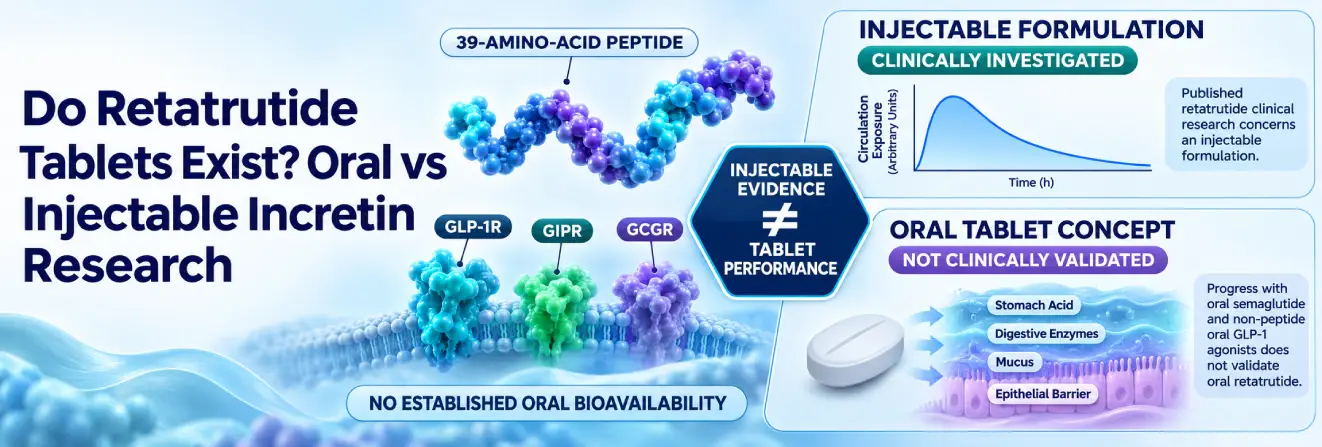
Retatrutide tablets are not currently an approved or clinically validated pharmaceutical formulation. Published clinical research focuses on injectable retatrutide, a synthetic peptide that activates GLP-1, GIP and glucagon receptors involved in metabolic regulation.
Developing an oral formulation presents significant scientific challenges, including gastrointestinal degradation, limited epithelial permeability and uncertain bioavailability.
Although oral semaglutide and non-peptide compounds such as orforglipron demonstrate advances in incretin research, their formulation characteristics cannot establish the oral performance of retatrutide.
The distinction between oral and injectable formulations depends on molecular structure, peptide stability, absorption mechanisms and compound-specific pharmacokinetic evidence, alongside current clinical research and Australian regulatory requirements.
Do Retatrutide Tablets Currently Exist?
No approved retatrutide tablet or capsule has been established. The compound remains under clinical investigation, and its documented development programme focuses on an injectable peptide formulation.
Although oral incretin compounds are an established area of pharmaceutical research, each molecule presents different structural and pharmacokinetic challenges.
What Published Retatrutide Clinical Trials Have Investigated
Retatrutide, also identified by its development code LY3437943, is being developed by Eli Lilly and Company as an investigational triple hormone receptor agonist.
Understanding what Reta peptide is helps explain why its molecular structure presents different formulation challenges from those of small-molecule compounds.
Its clinical development has progressed through early pharmacological investigations, Phase 2 studies and larger Phase 3 trials.
The TRIUMPH clinical research programme examines retatrutide across several metabolic research populations. Peer-reviewed Phase 3 findings published in 2026 have expanded the available evidence concerning its pharmacological activity and clinical safety profile.
These investigations concern the injectable formulation. They do not establish whether an oral formulation could deliver sufficient quantities of intact retatrutide into systemic circulation or produce comparable receptor activity.
Even successful late-stage clinical research does not automatically validate alternative formulations of the same compound.
Why Products Labelled as Reta Tablets Do Not Establish Scientific Evidence
The appearance of products described as reta tablets or retatrutide capsules does not demonstrate that a scientifically validated oral formulation exists.
A pharmaceutical formulation comprises more than its stated active ingredient. Its composition, physical characteristics, stability and interaction with biological environments influence its performance.
Several independent questions therefore arise when evaluating an oral peptide formulation:
- Does the material contain the declared peptide?
- Does its molecular structure remain intact within the formulation?
- Can the peptide withstand gastrointestinal conditions?
- Is there measurable absorption of biologically active material?
- Has its pharmacological activity been independently characterised?
Confirming chemical identity addresses only the first stage of this evaluation. A tablet may contain a particular peptide without demonstrating meaningful systemic absorption.
Why Retatrutide Is Investigated as an Injectable Peptide
Peptide molecules differ from conventional small-molecule compounds in their molecular size, chemical structure and interactions with biological membranes.
Retatrutide’s documented injectable formulation avoids the gastrointestinal absorption barriers that complicate the development of many orally delivered peptides.
Retatrutide’s Molecular Structure and Triple Receptor Activity
Retatrutide is a synthetic peptide engineered to activate three distinct G protein-coupled receptors:
- Glucagon-like peptide-1 receptor (GLP-1R): Investigated for its role in glucose-dependent insulin secretion, appetite signalling and gastrointestinal regulation.
- GIP receptor (GIPR): Associated with nutrient-responsive insulin secretion and metabolic signalling.
- Glucagon receptor (GCGR): Involved in hepatic glucose metabolism, substrate utilisation and energy regulation.
The retatrutide triple agonist mechanism involves interconnected metabolic pathways, although the individual contribution of each receptor remains under scientific investigation.
Retatrutide also incorporates molecular modifications that support prolonged systemic exposure. Its lipid-associated structural features contribute to interactions with circulating albumin, influencing how the peptide is distributed and cleared.
Such modifications are important in long-acting peptide research because unmodified peptides can undergo relatively rapid enzymatic degradation or elimination.
However, molecular features that prolong circulation do not necessarily improve absorption through the gastrointestinal tract.
Systemic Exposure and Peptide Stability
Systemic exposure describes the extent and duration to which a compound is present in circulation.
For peptides such as retatrutide, exposure depends on multiple factors, including molecular stability, protein binding, tissue distribution and clearance.
An injectable formulation encounters a different biological environment from an oral formulation. It avoids initial exposure to digestive enzymes and the gastrointestinal epithelial barrier, although absorption and degradation within other tissues can still influence its pharmacokinetics.
An oral formulation introduces additional variables before the peptide reaches circulation. Consequently, the characteristics that support prolonged retatrutide exposure following injection cannot be assumed to provide equivalent oral absorption.
This distinction separates two fundamental areas of pharmaceutical research: maintaining molecular stability after absorption and achieving absorption in the first place.
Scientific Barriers to Developing Oral Retatrutide
Oral peptide delivery remains a challenging area of pharmaceutical science. Unlike many conventional small molecules, peptides must retain their molecular integrity while passing through an environment designed to break down proteins and other biological materials.
Three major considerations are gastrointestinal degradation, epithelial permeability and the consistency of systemic absorption.
Gastrointestinal Degradation and Proteolytic Enzymes
The gastrointestinal tract contains enzymes that break proteins and peptides into smaller fragments and individual amino acids.
In the stomach, acidic conditions support the activity of pepsin, an enzyme that cleaves peptide bonds. Further degradation can occur in the small intestine through pancreatic enzymes, including trypsin and chymotrypsin, alongside other intestinal peptidases.
For an investigational peptide such as retatrutide, cleavage of its amino acid sequence could alter the structural features required for receptor recognition.
Even partial fragmentation may affect:
- Molecular conformation.
- Receptor-binding affinity.
- Selectivity between receptor subtypes.
- Biological activity.
- Pharmacokinetic behaviour.
Although synthetic peptides can incorporate modifications that improve resistance to particular enzymes, resistance to one degradation pathway does not guarantee stability throughout the gastrointestinal tract.
Retatrutide’s engineered structure therefore cannot be considered evidence of gastrointestinal stability without formulation-specific experimental findings.
Molecular Size and Epithelial Permeability
Retatrutide consists of a modified 39-amino-acid peptide backbone with a fatty diacid modification that supports albumin binding and prolonged systemic circulation. Its molecular structure is more complex than that of many orally absorbed small molecules.
Several factors can limit peptide absorption through the gastrointestinal epithelium:
- Molecular size: Larger peptide molecules generally exhibit limited passive membrane permeability.
- Polarity and hydrogen bonding: These molecular properties can restrict transport across epithelial cell membranes.
- Epithelial barrier: Selective cellular membranes limit the passage of intact peptide molecules.
- Mucus layer: Interactions with mucus components may restrict peptide diffusion towards epithelial surfaces.
Importantly, solubility does not guarantee absorption. A peptide may dissolve readily while remaining poorly absorbed because of its molecular characteristics and limited epithelial permeability.
Oral Bioavailability and Pharmacokinetic Variability
Bioavailability describes the proportion of a compound that reaches systemic circulation in an unchanged form following exposure through a particular route.
For orally delivered peptides, bioavailability depends on several sequential processes, including release from the formulation, resistance to degradation, movement through biological barriers and absorption.
Variability can arise from differences in gastrointestinal conditions, digestive enzyme activity, transit times and physiological characteristics.
Researchers must therefore distinguish between detecting peptide-derived fragments and detecting the original, biologically active molecule.
The presence of degradation products does not demonstrate that intact retatrutide has reached circulation or retained its triple receptor activity.
No clinically established oral bioavailability value is currently available for retatrutide. Assigning an absorption percentage based on other peptides would be scientifically unsupported.
Biological Barriers to Oral Peptide Delivery
| Scientific barrier | Potential effect on peptide delivery |
| Gastric acidity | May influence molecular stability and enzyme-mediated degradation |
| Proteolytic enzymes | Can cleave peptide bonds and alter molecular integrity |
| Gastrointestinal mucus | May restrict diffusion towards epithelial surfaces |
| Epithelial permeability | Can limit the transport of intact peptide molecules |
| Gastrointestinal transit | Influences exposure to digestive conditions |
| Absorption variability | May contribute to inconsistent systemic exposure |
Research reviews published in 2025 and 2026 continue to identify these interacting barriers as major limitations in oral peptide formulation development.
Discover more about peptide science at Australia Peptide Sciences.
Oral vs Injectable Incretin Research: How the Compounds Differ
The development of oral incretin receptor agonists demonstrates that pharmaceutical researchers can approach receptor activation through different molecular designs.
However, compounds belonging to the same broad pharmacological category are not necessarily interchangeable. Their chemical structures, receptor interactions and formulation requirements can differ substantially.
Research involving GLP-1 research peptides examines how molecular structure and receptor selectivity influence biological activity in experimental models.
Oral Semaglutide and SNAC Technology
Semaglutide is a modified GLP-1 analogue developed in both injectable and oral formulations. Its oral formulation represents an important advancement in peptide delivery research because it addresses several barriers associated with gastrointestinal absorption.
Oral semaglutide incorporates an absorption enhancer known as SNAC, or salcaprozate sodium.
Research published in Science Translational Medicine in 2018 identified a distinctive absorption mechanism associated with this formulation. Experimental findings indicated that semaglutide absorption occurs primarily through the gastric epithelium near the dissolving tablet.
The research identified two important functions associated with SNAC:
- Reducing local exposure to conditions that promote enzymatic degradation.
- Facilitating the movement of semaglutide across gastric epithelial cells.
This behaviour depends on the interaction between semaglutide, its formulation components and the surrounding biological environment.
The Australian Therapeutic Goods Administration (TGA) published its assessment of Wegovy in tablet form in November 2026, reflecting continued progress in the pharmaceutical development of oral peptide formulations.
Nevertheless, the scientific evidence supporting oral semaglutide remains specific to that compound and its evaluated formulation. It does not demonstrate that retatrutide shares the same absorption characteristics.
The following video explains the scientific challenges of oral peptide delivery and the role of absorption-enhancing technology in oral semaglutide formulations.
Orforglipron as a Non-Peptide Oral GLP-1 Receptor Agonist
Orforglipron is an oral, non-peptide small-molecule GLP-1 receptor agonist that represents a distinct approach to incretin research.
Its key differences from retatrutide include:
- Molecular structure: Orforglipron is a small molecule rather than an amino acid-based peptide.
- Gastrointestinal stability: It is not subject to the same peptide-specific enzymatic degradation mechanisms.
- Receptor activity: It targets GLP-1 receptors, whereas retatrutide activates GLP-1, GIP and glucagon receptors.
- Formulation: Its physicochemical properties present different challenges for oral delivery.
Peer-reviewed Phase 3 research published in 2025 characterised orforglipron as an oral GLP-1 receptor agonist. In November 2026, its tablet formulations were registered in the Australian Register of Therapeutic Goods (ARTG).
Orforglipron is therefore a distinct pharmaceutical compound, not an oral version of retatrutide.
Comparison of Oral and Injectable Incretin Compounds
| Compound | Molecular class | Receptor targets | Documented formulation |
| Retatrutide | Synthetic peptide | GLP-1R, GIPR, GCGR | Investigational injectable |
| Semaglutide | Modified peptide | GLP-1R | Oral and injectable |
| Tirzepatide | Synthetic peptide | GIPR, GLP-1R | Injectable |
| Orforglipron | Non-peptide small molecule | GLP-1R | Oral |
The comparison highlights differences in molecular design and receptor activity rather than comparative therapeutic performance.
A scientific comparison of retatrutide vs tirzepatide further illustrates the differences between triple and dual receptor agonism.
Why Evidence From Other Incretin Compounds Cannot Validate Oral Retatrutide
Two compounds can activate the same receptor while exhibiting different binding characteristics, absorption behaviour and metabolic stability.
For dual receptor agonists such as tirzepatide, formulation-specific evidence is equally important.
Even among structurally related peptides, variations in amino acid sequence and chemical modification can influence how molecules interact with formulation components and biological membranes.
Evidence from oral semaglutide establishes the performance of a particular peptide formulation. Evidence from orforglipron establishes a different small-molecule approach.
Neither provides direct evidence that retatrutide tablets would achieve measurable systemic exposure, preserve triple receptor activity or demonstrate an acceptable formulation-specific safety profile.
Such conclusions require independent research on retatrutide itself.
What Clinical Research Reveals About Retatrutide Formulations
Retatrutide’s clinical development has generated a growing body of evidence concerning its pharmacological activity. The formulation investigated remains central to interpreting those findings.
What the Phase 2 and Phase 3 Studies Establish
Phase 2 research published in 2023 characterised retatrutide’s metabolic effects and initial clinical safety profile. Subsequent Phase 3 investigations expanded this evidence through larger study populations, longer observation periods and additional clinical endpoints.
In 2026, peer-reviewed publications reported findings from TRIUMPH-1 and other Phase 3 studies, including research involving obesity and knee osteoarthritis. The published retatrutide Phase 3 results provide further evidence of its pharmacological characteristics.
However, these findings remain specific to the investigated formulations, study populations and experimental conditions. Evidence from injectable retatrutide cannot establish the absorption, bioavailability or pharmacological performance of an oral formulation.
Why Injectable Clinical Data Cannot Establish Oral Formulation Performance
Pharmacokinetics examines how biological systems absorb, distribute, metabolise and eliminate a compound.
Changing the delivery route can alter several pharmacokinetic parameters, even when the active molecular structure remains unchanged.
Important parameters include:
- Maximum plasma concentration (Cmax): The highest measured concentration during an observation period.
- Time to maximum concentration (Tmax): The interval required to reach that concentration.
- Area under the concentration-time curve (AUC): A measure of overall systemic exposure across a defined period.
- Elimination half-life: The time required for the plasma concentration of a compound to decrease by 50% during the elimination phase.
These parameters help researchers characterise formulation performance and investigate relationships between exposure and biological activity.
An oral retatrutide formulation would require its own pharmacokinetic evidence. Without such data, equivalent exposure or biological responses cannot be assumed from injectable studies.
Safety findings would also require independent evaluation because formulation components, gastrointestinal interactions and exposure patterns could introduce different characteristics.
Could an Oral Retatrutide Formulation Be Developed in the Future?
The development of oral peptide formulations remains an active area of pharmaceutical research. Advances in molecular engineering and delivery technologies have expanded the range of compounds investigated for oral absorption.
Nevertheless, the theoretical possibility of developing an oral retatrutide formulation must be distinguished from demonstrated experimental success.
Emerging Approaches in Oral Peptide Delivery Research
Several areas of pharmaceutical research examine how peptide stability and absorption might be improved.
Other peptide agonists, including mazdutide, also illustrate the diversity of molecular designs investigated in incretin research.
Absorption-enhancing technologies
Researchers investigate compounds that influence the interaction between peptide molecules and epithelial barriers. Their performance depends on the molecular characteristics of the peptide and the biological environment in which absorption occurs.
Protective delivery systems
Encapsulation and carrier-based technologies are being studied for their ability to protect biological molecules from environmental degradation. Experimental findings vary depending on the characteristics of both the carrier and the peptide.
Molecular engineering
Structural modifications may influence enzyme resistance, molecular stability and interactions with biological membranes. However, changes intended to improve absorption can also alter receptor recognition or biological activity.
Gastrointestinal stability research
Experimental models allow researchers to investigate how pharmaceutical compounds behave under different gastrointestinal conditions. These models provide valuable preliminary information but cannot independently establish clinical bioavailability.
Recent scientific reviews published in 2026 describe continued progress across these technologies while identifying substantial limitations in translating experimental findings into reproducible pharmaceutical formulations.
None of these broader technological developments independently confirms that an oral retatrutide formulation has been successfully developed.
What Evidence Would Be Required to Validate Oral Retatrutide?
Establishing a scientifically credible oral formulation would require evidence across several complementary research disciplines.
| Research area | Evidence required |
| Molecular identity | Confirmation that the active compound corresponds to the intended retatrutide structure |
| Formulation stability | Evidence that molecular integrity is maintained within the formulation |
| Gastrointestinal stability | Characterisation of peptide degradation under relevant biological conditions |
| Absorption | Evidence that intact retatrutide reaches systemic circulation |
| Pharmacokinetics | Characterisation of systemic exposure and its variability |
| Pharmacodynamics | Evidence of retained activity at the intended receptor targets |
| Safety | Independent evaluation of formulation-specific safety characteristics |
| Reproducibility | Consistent findings across appropriately designed investigations |
Each category addresses a separate scientific question.
For example, confirming that a tablet contains retatrutide does not establish that the peptide remains intact after exposure to gastrointestinal conditions. Similarly, detecting an intact peptide in circulation does not independently establish the magnitude or duration of its receptor activity.
A credible formulation requires complementary evidence rather than reliance on a single analytical result.
Until such findings become available, oral retatrutide remains an unvalidated formulation concept rather than an established pharmaceutical development.
Retatrutide Tablets and Regulatory Status in Australia
The Australian regulatory environment provides an important distinction between investigational compounds, approved pharmaceutical formulations and materials associated with laboratory research.
These classifications are not interchangeable, and each is associated with different scientific and regulatory requirements.
Current TGA Approval Status
As of 24 November 2026, retatrutide has not been approved by the Therapeutic Goods Administration (TGA) for therapeutic use in Australia.
Clinical development and regulatory approval involve distinct assessment processes:
- Clinical trials: Evaluate pharmacological activity, clinical outcomes and safety under controlled research conditions.
- Pharmaceutical quality assessments: Examine molecular identity, formulation stability and manufacturing quality.
- ARTG registration: Requires regulatory assessment of the product’s quality, safety and effectiveness before approval.
The publication of Phase 3 results does not automatically establish regulatory approval. Similarly, approval of other oral incretin compounds does not extend to retatrutide, as each pharmaceutical formulation requires its own supporting evidence.
There is currently no confirmed Australian approval date for retatrutide tablets.
Product Labelling and Analytical Evidence
In laboratory research, analytical documentation provides important information about the identity and characteristics of peptide materials.
A Certificate of Analysis (COA) may report findings related to molecular identity, chromatographic purity and other measured properties. Its scientific value depends on the analytical methods used, the scope of testing and its relationship to the specific batch.
Common analytical methods in peptide research include:
- High-performance liquid chromatography (HPLC): Used to investigate chromatographic purity and identify detectable impurities.
- Mass spectrometry (MS): Used to characterise molecular mass and support compound identification.
- Liquid chromatography-mass spectrometry (LC-MS): Combines chromatographic separation with mass-based molecular detection.
These techniques provide complementary information, but analytical characterisation is not equivalent to pharmaceutical formulation validation.
For example, a chromatographic purity result does not independently establish the quantity of intact peptide within a tablet, its gastrointestinal stability or its capacity for systemic absorption.
A COA cannot establish oral bioavailability, which requires independent pharmacokinetic evidence.
The research peptide catalogue lists materials designated for laboratory research.
Australian Regulatory Testing of Unapproved Peptide Products
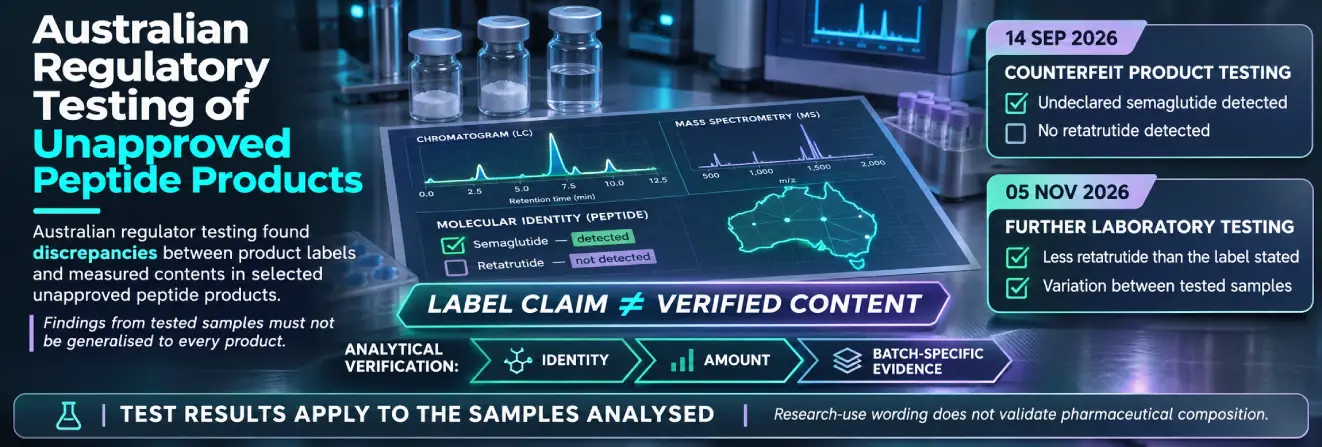
During 2026, the TGA issued several safety alerts highlighting discrepancies between product labelling and laboratory testing of unapproved peptides.
Two notable alerts include:
- 14 September 2026: The TGA reported analytical findings concerning a counterfeit retatrutide product following a serious adverse event report.
- 5 November 2026: Further laboratory testing identified discrepancies between declared ingredients and the measured contents of unapproved peptide products.
These findings highlight the importance of independent analytical verification without implying that all unapproved peptide products share the same characteristics.
The TGA also emphasises that research-use disclaimers alone do not establish regulatory compliance. Obligations depend on the product’s nature, presentation and intended purpose. Laboratory research materials must remain distinct from products intended for human or veterinary applications.
The Scientific Evidence Behind Retatrutide Formulations
Retatrutide remains an investigational triple receptor agonist whose published clinical development centres on injectable formulations. No approved or clinically validated retatrutide tablet has been established.
The scientific challenges associated with oral peptide delivery extend beyond molecular identity. Gastrointestinal degradation, epithelial permeability, formulation stability and pharmacokinetic variability all influence whether a peptide can achieve measurable systemic exposure.
Oral semaglutide and non-peptide compounds such as orforglipron demonstrate different approaches to incretin receptor research. Their development illustrates progress in pharmaceutical science without establishing the performance of oral retatrutide.
Future claims concerning retatrutide tablets require independent, compound-specific evidence demonstrating molecular integrity, absorption, receptor activity and formulation-specific safety. Until such evidence becomes available, injectable research findings cannot be extrapolated to an oral formulation.
Explore Retatrutide for laboratory research → View specifications, pricing and Certificates of Analysis.
FAQs retatrutide tablets
Are retatrutide tablets available in Australia?
There are currently no TGA-approved retatrutide tablets in Australia. Retatrutide remains an investigational compound, and its documented clinical development focuses on injectable formulations. Products described as oral retatrutide do not independently establish regulatory approval or pharmaceutical validity.
Is there an oral version of retatrutide?
No clinically validated oral version of retatrutide has been established. Although oral peptide delivery is an active research field, published retatrutide clinical studies have focused on injectable formulations. Compound-specific absorption and pharmacokinetic evidence would be required to validate an oral version.
Are reta tablets the same as retatrutide injections?
Scientific equivalence has not been established. Even if two formulations contain the same active peptide, differences in gastrointestinal stability, absorption and systemic exposure can substantially influence their pharmacological characteristics. Injectable retatrutide research does not establish tablet performance.
Why is retatrutide classified as a peptide rather than a small-molecule compound?
Retatrutide contains a chemically modified chain of 39 amino acids. Its peptide-based molecular architecture distinguishes it from non-peptide small molecules, which have different chemical structures, physicochemical properties and interactions with biological absorption pathways.
Is oral semaglutide the same as oral retatrutide?
No. Semaglutide and retatrutide have different molecular structures and receptor targets. Semaglutide activates the GLP-1 receptor, whereas retatrutide also activates GIP and glucagon receptors. Evidence supporting oral semaglutide does not validate an oral retatrutide formulation.
Is orforglipron an oral form of retatrutide?
No. Orforglipron is a non-peptide small-molecule GLP-1 receptor agonist. Retatrutide is a synthetic triple receptor agonist peptide. Although both are associated with incretin research, they represent distinct molecular and pharmaceutical approaches.
Can a Certificate of Analysis prove oral bioavailability?
No. A Certificate of Analysis can document specific analytical characteristics, such as molecular identity or chromatographic purity. Oral bioavailability requires separate pharmacokinetic evidence demonstrating that the intact compound reaches systemic circulation through the oral route.
Could retatrutide tablets be developed in the future?
Future development is scientifically conceivable, given ongoing advances in oral peptide delivery. However, the feasibility of an oral retatrutide formulation has not been clinically established. Dedicated research would be required to characterise its stability, absorption, pharmacological activity and safety.
Is there a tablet equivalent to Mounjaro?
No approved tablet formulation of tirzepatide, the active compound in Mounjaro, has been established in Australia. Although oral incretin receptor agonists exist, their molecular structures, receptor targets and pharmacokinetic characteristics differ from those of injectable tirzepatide.
Is retatrutide safer than tirzepatide?
The available scientific evidence does not establish that retatrutide has a more favourable safety profile than tirzepatide. The Phase 3 TRIUMPH-5 study directly investigates both compounds, but comparative safety conclusions require sufficiently detailed clinical evidence and longer-term observations.
Has a development timeline been announced for oral retatrutide?
As of November 2026, no publicly confirmed development timeline has been announced for an oral retatrutide formulation. Published clinical research continues to focus on the injectable peptide.
References
- gov - Retatrutide Phase 3 Clinical Trial (TRIUMPH-1)
- PubMed - Scientific Barriers to Oral Protein and Peptide Delivery
- PubMed - Gastric Absorption of Semaglutide and SNAC Technology
- PubMed - Orforglipron: Oral Small-Molecule GLP-1 Receptor Agonist Research
- Therapeutic Goods Administration (TGA) - Laboratory Testing and Labelling Discrepancies in Unapproved Peptide Products
- Therapeutic Goods Administration (TGA) - Australian Regulatory Requirements for Unapproved Peptide Products