
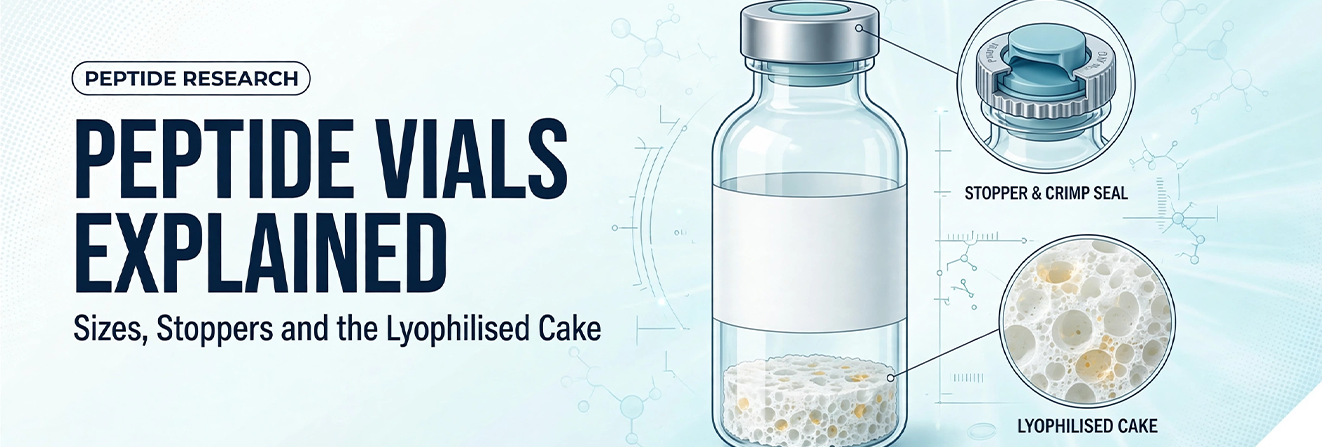
A peptide vial can look empty before reconstitution because a small amount of freeze-dried material may be difficult to see through the glass. When inspecting a sealed vial for laboratory research, check the dried material, the closure and the batch label separately.
Quick answer: Freeze-dried material may appear as a shallow layer at the base of the vial or a faint deposit on the inner wall. If no material is visible, keep the vial sealed and ask the supplier to confirm the expected appearance using the product name and batch number.
Why Can a Peptide Vial Look Empty Before Reconstitution?
Freeze-drying removes water from a formulation, leaving the peptide and any other solids behind. When the formulation has a low total solids content, the dried material can form a thin layer across the base. A label that covers the lower part of the vial can make that layer harder to see.
In their study of vial fogging, Kaur and colleagues describe how a thin film of dried material can appear on the inner wall above the cake. They also note that a deposit near the vial neck can affect closure integrity if it reaches the sealing surface.
The thickness of a visible deposit cannot tell you how much peptide is present. To describe what you see, inspect the base and lower wall from more than one angle without opening the vial.
Peptide Vial Sizes and What the Numbers Mean
Peptide vial sizes describe the container. A size in millilitres gives its nominal capacity, while a quantity in milligrams usually gives the declared mass of peptide per vial. The liquid fill before freeze-drying and the volume of the prepared solution are separate measurements.
| Measurement | Unit | What it describes |
| Nominal vial capacity | mL | The stated size of the container |
| Fill volume before drying | mL | The volume of liquid formulation originally placed in the vial |
| Labelled peptide amount | mg | The declared mass of peptide per vial |
| Total dry solids | mg | The combined mass of the peptide and any other solids in the dried formulation |
| Closure diameter | mm | The stated diameter of the closure fitting |
The SCHOTT adaptiQ vial specifications published by West list nominal capacities of 3 mL, 8 mL and 10 mL. For an APS vial’s capacity and dimensions, check its own packaging specification.
In a hypothetical example, a 2 mL vial labelled 5 mg has a nominal capacity of 2 mL and a declared peptide amount of 5 mg. Neither figure gives the expected height of the dried deposit. A wider vial can spread the same volume of dried material across a larger base, making the deposit shallower.
The distinction is visible in research catalogue listings. For Selank 10 mg, the product specification identifies 10 mg as the quantity per vial and lists lyophilised powder separately as the physical form.
When comparing listings in the neuropeptides for research category, read each product specification for its declared amount and physical form. If the container dimensions matter for sample intake or storage, check the packaging specification for that product.
This BioNetwork animation shows how ice turns directly into water vapour during freeze-drying and when the vials are sealed.
How the Rubber Stopper and Vial Crimp Seal Work
1. The Stopper Seals Against the Vial Rim
The stopper is made from a flexible material called an elastomer. A technical review of freeze-drying explains that vented stoppers sit partway in the vial during drying so water vapour can escape. After drying, the stopper is fully seated against the vial rim.
2. The Aluminium Crimp Holds the Stopper in Place
The vial crimp seal is the aluminium band fitted around the neck of the vial. It holds the stopper against the rim. An FDA-reviewed packaging example shows how a plastic flip-off cap can cover the centre of the stopper. The glass, stopper and crimp work together as the container closure system.
Visual inspection can reveal a displaced stopper, a torn crimp or cracked glass. Some defects are too small to see. The FDA guidance on container closure integrity explains how testing can assess whether the assembled package maintains its barrier.
Browse our Australian peptide catalogue for research use only
What Is a Lyophilised Cake?
A lyophilised cake is the solid structure left after a formulation is freeze-dried. During primary drying, ice changes directly into vapour under reduced pressure through sublimation. A later drying stage reduces moisture that remains associated with the dried material. The recommended practices for lyophilisation validation identify residual moisture and cake appearance as separate quality attributes.
The cake can contain the peptide and any excipients added to the formulation. Some excipients help give the dried material a defined structure. A review of cake appearance by Patel and colleagues explains how the formulation and fill affect the visible cake. Two vials with the same declared peptide amount can therefore have cakes of different sizes if their formulations contain different amounts of other solids.
A product description may use freeze-dried powder without specifying whether the material should appear as a cohesive cake. For example, DSIP 5 mg is listed as a freeze-dried powder. For an acceptance decision, use the documented appearance for the specific product and batch.
The shape of the dried material describes the formulation at a visible scale. At the molecular level, the amino acid order defines the peptide’s primary structure. The peptide sequence guide explains how researchers describe and verify that order.
Some materials also have structural features beyond the amino acid sequence. GHK-Cu, for example, is a copper-bound tripeptide supplied as a freeze-dried powder. Its appearance cannot confirm copper coordination or molecular identity.
The guide to lyophilised peptides explains how freeze-drying changes the physical form of a formulation and which quality attributes require separate measurements.
What to Check Before Laboratory Reconstitution
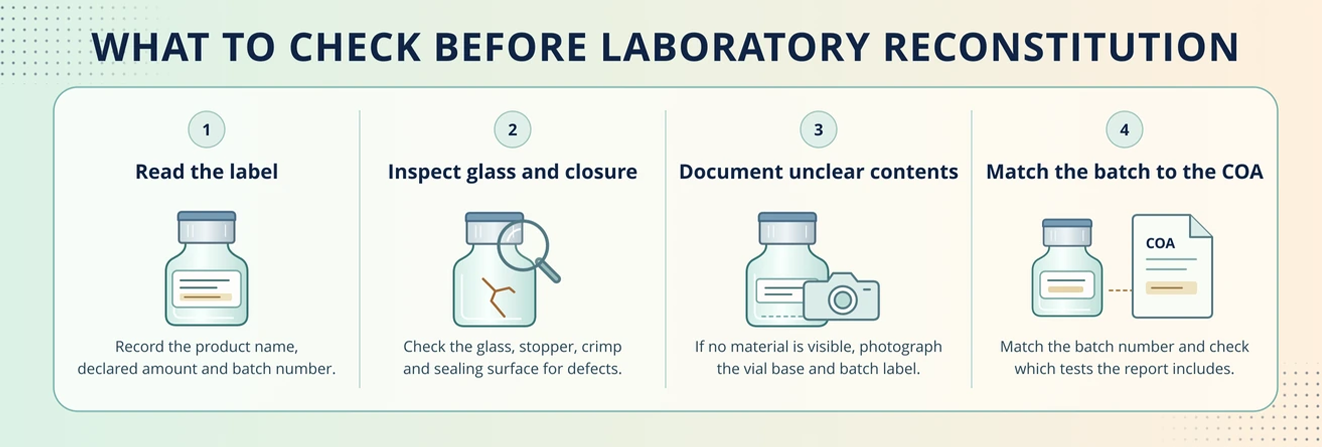
The FDA guidance on aseptic processing describes how defects such as vial fractures can compromise the container closure system. For a sealed research sample, collect the following information before opening the vial.
- Read the label. Record the product name, declared amount and batch number.
- Inspect the glass and closure. Set the sealed vial aside if the glass is cracked, the stopper is displaced, the crimp is damaged or material is lodged at the sealing surface. Follow your laboratory’s sample acceptance procedure.
- Document unclear contents. If no material is visible, photograph the base and the batch label. Ask the supplier to confirm the expected appearance for that batch.
If a certificate of analysis (COA) is available, match its batch number to the vial and check which tests it reports. Identity, purity and peptide content answer different questions. The peptide COA guide explains how to interpret those results.
Match the vial’s batch number to the relevant report in the batch certificates of analysis where records are available. The report describes the sample tested and cannot resolve a visible problem with an individual vial.
Assessing a Sealed Research Vial
A peptide vial gives you three kinds of information. The label identifies the declared material and batch, the closure shows the visible condition of the packaging, and the cake shows the physical form of the dried formulation. If the contents are unclear or the closure appears damaged, keep the vial sealed and resolve the discrepancy before laboratory reconstitution.
Explore Australia Peptide Sciences
Explore Bacteriostatic Water for laboratory research → View specifications, pricing and Certificates of Analysis.
FAQs About Vial Packaging and Appearance
Why do peptide vials have a rubber stopper and crimp seal?
The rubber stopper seals against the glass rim. The aluminium crimp holds the stopper in place.
What is a lyophilised cake?
It is the solid structure left after a formulation is freeze-dried. It can contain both the peptide and other formulation solids.
Why might a vial look empty before reconstitution?
A small amount of dry material can form a shallow layer or faint deposit that is difficult to see. If the vial still appears empty after inspection, keep it sealed and ask the supplier to check the expected appearance for that batch.
Does the colour of the flip-off cap identify the peptide?
Cap colour can be part of a supplier’s packaging system. Use the label and batch documentation to identify the declared material.
Does an apparently empty vial contain a vacuum?
The space above the contents is called headspace. Its appearance gives no information about pressure inside the vial.
Does a cracked cake mean the glass vial is damaged?
A crack in the cake describes the dried material. Inspect the glass separately and set the vial aside if the glass is visibly cracked.
Can a dry-looking cake still contain moisture?
Yes. Freeze-dried material can retain residual moisture, which requires an appropriate analytical test to measure.
Is all lyophilised peptide material white?
Colour can vary with the formulation. Compare what you see with the documented appearance for that product.
Can weighing the sealed vial confirm the amount of peptide?
The gross weight includes the packaging and all formulation solids. Measuring the amount of peptide requires a suitable assay.
Does a smooth cake establish how long the peptide can be stored?
Storage periods depend on stability data for the specific formulation, packaging and storage conditions. Cake appearance alone cannot establish shelf life.
External References
- West Pharmaceutical Services. SCHOTT adaptiQ vial specifications.
- Patel et al. (2017). Lyophilized Drug Product Cake Appearance: What Is Acceptable? Journal of Pharmaceutical Sciences
- Practical advice in the development of a lyophilized protein drug product. Antibody Therapeutics
- Kaur et al. (2024). Demystifying Fogging in Lyophilized Products: Impact of Pharmaceutical Processing. Journal of Pharmaceutical Sciences
- Recommended Best Practices for Lyophilization Validation 2021 Part II: Process Qualification and Continued Process Verification. PubMed Central
- US Food and Drug Administration. Container and Closure System Integrity Testing in Lieu of Sterility Testing as a Component of the Stability Protocol for Sterile Products. FDA guidance
- US Food and Drug Administration. Sterile Drug Products Produced by Aseptic Processing - Current Good Manufacturing Practice. FDA guidance
- US Food and Drug Administration. Chemistry Review for NDA 214200, cited as an example of a vial, stopper and aluminium crimp configuration. FDA review