

This is one of the most common questions in skincare today: Do collagen supplements actually work? The short answer is: it depends on what you expect them to do.
Collagen supplements are widely marketed as a solution for improving skin appearance, reducing wrinkles, and boosting elasticity. But scientifically, the story is more nuanced.
When you consume collagen, your body breaks it down into amino acids during digestion. These amino acids are then reused to support various functions in the body, not just the skin.
So while collagen supplements may contribute to overall protein intake, they do not directly “replace” collagen in the skin.
What Does Collagen Do for Skin?
To understand whether supplements work, you first need to understand what collagen does for skin.
Collagen is the structural protein that helps maintain:
- Skin firmness
- Elasticity
- Smooth texture
- Hydration support
It acts like a support system beneath the surface, keeping the skin looking plump and resilient.
As collagen levels decline with age, the skin gradually loses its structure, leading to:
- Fine lines
- Wrinkles
- Loss of firmness
- Thinner skin
Do Collagen Supplements Actually Work for Skin?
When people ask “Do collagen supplements actually work?” they are usually referring to powders, capsules, or drinks marketed for improving skin.
What Happens When You Take Collagen Supplements?
Collagen supplements typically contain hydrolyzed collagen (collagen peptides), which are broken down into smaller amino acids for easier digestion.
Once consumed:
- Collagen is digested into amino acids
- These amino acids enter the bloodstream
- The body uses them where needed (not just skin)
This means collagen supplements do not directly go to your skin and “replace” lost collagen.
What Does Research Say About Collagen Supplements?
Some studies suggest collagen supplements may support:
- Skin hydration
- Elasticity
- Reduction in visible wrinkles (in some cases)
However, results vary depending on:
- Dosage
- Duration of use
- Individual metabolism (explore more: What is metabolic health?)
- Overall lifestyle
Key Reality:
Collagen supplements may support skin appearance, but they are not a guaranteed or standalone solution.
Collagen Supplements vs Natural Collagen Production
Here’s the key difference most people miss:
| Collagen Supplements | Natural Collagen Support |
| Provide amino acids | Stimulate internal production |
| Indirect effect | Direct biological process |
| Short-term support | Long-term impact |
| Dependent on digestion | Driven by lifestyle + biology |
This is why many experts focus more on supporting collagen production rather than relying only on supplements.
Are Collagen Supplements Worth It?
If you’re wondering whether collagen supplements are worth taking:
They can help if:
- Your diet is low in protein
- You’re consistent over time
- You combine them with good lifestyle habits
They are less effective if:
- You expect instant results
- You rely on them alone
- Lifestyle factors (sleep, sun, diet) are poor :
Collagen supplements can support skin health, but they work best as part of a bigger system, not as a quick fix.
Collagen for Skin: What Actually Works?
When it comes to collagen for skin, research suggests that supporting the body’s natural processes is more effective than relying on a single product.
Here’s what actually helps:
Nutrition
Protein, Vitamin C, and antioxidants play a key role in natural collagen production.
Sun Protection
UV exposure is one of the biggest contributors to collagen breakdown.
Sleep and Recovery
Collagen repair and skin regeneration happen primarily during sleep.
Lifestyle Consistency
Long-term habits matter more than short-term solutions.
Can Collagen Be Absorbed Through Skin?
A very common myth is that collagen can be directly absorbed through creams or topical products.
So, can collagen be absorbed through skin?
In most cases, the answer is no.
Collagen molecules are too large to penetrate deeply into the skin. Most topical collagen products work by:
- Providing hydration
- Improving surface appearance temporarily
But they do not directly rebuild collagen within deeper layers of the skin.
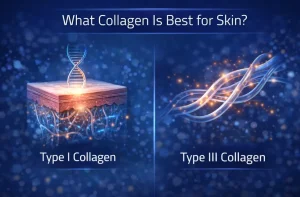
What Collagen Is Best for Skin?
If you’re wondering what collagen is best for skin, the answer depends on your goal.
Different types of collagen exist, but for skin health:
- Type I collagenis the most abundant and relevant for skin structure
- Type III collagensupports elasticity and firmness
However, instead of focusing only on collagen types, it’s more effective to focus on supporting collagen-related pathways within the body.
The Shift toward Collagen Support (Not Replacement)
Modern research is moving away from the idea of simply “adding collagen” and focusing more on supporting how the body produces and maintains it.
This includes:
- Supporting cellular communication
- Encouraging natural repair processes
- Maintaining skin function at a deeper level
This shift is why many researchers are now exploring therapeutic peptides as part of broader skin and aging studies.
The Role of Peptides in Collagen Research
Peptides are short chains of amino acids that act as signaling molecules. Some are studied for their potential interaction with biological processes linked to:
- Skin regeneration
- Collagen-related activity
- Cellular repair pathways
Unlike collagen itself, peptides may play a role in how the body communicates and regulates these processes.
Collagen-Related Peptides in Research
GHK-Cu (Research Peptide)
GHK-Cu is one of the most studied compounds in skin-related research. It is associated with:
- Collagen-related biological pathways
- Skin regeneration research
- Cellular repair mechanisms
Because of its relevance in research models, it continues to be widely explored in studies related to skin health and aging.
Glow Blend (Research Compound)
Glow Blend is a multi-compound formulation designed for advanced research into skin-related pathways. It is used in laboratory environments where multiple mechanisms are studied together.
Important: Research Use Only
All peptides mentioned in this article, including GHK-Cu and Glow Blend, are provided strictly for:
- Laboratory research
- Scientific investigation
- Educational purposes
They are not intended for human consumption, cosmetic use, or medical application.
So, Do Collagen Supplements Actually Work?
Let’s bring it all together.
Do collagen supplements actually work?
- They may contribute to overall protein intake
- They support general nutritional needs
- But they do not directly replace collagen in the skin
The Real Answer:
Collagen supplements alone are not a complete solution.
Supporting skin health requires a broader approach that includes:
- Nutrition
- Lifestyle
- Skin protection
- Internal biological support
A Smarter Approach to Skin Health
Instead of relying on a single solution, modern skin science focuses on:
- Supporting natural collagen production
- Maintaining skin function
- Understanding biological pathways
- Long-term consistency
This is why the conversation is shifting from quick fixes → long-term support strategies.
Explore Skin Research Compounds
At Australia Peptide Sciences, we provide high-purity research peptides designed for scientific exploration in skin, hair, and aging-related pathways.
Our research catalogue includes:
- GHK-Cu
- Glow Blend
Each product is manufactured to strict laboratory standards to ensure purity, consistency, and reliability.
Explore GHK-Cu for laboratory research → View specifications, pricing and Certificates of Analysis.
FAQs About Collagen Supplements
Do collagen supplements actually work for skin?
Collagen supplements may support skin hydration and elasticity over time, but they do not directly replace collagen in the skin. Results depend on consistency, dosage, and overall lifestyle.
How long does it take for collagen supplements to work?
Most people who take collagen supplements consistently may notice changes in skin appearance within 4 to 12 weeks, depending on individual factors and product quality.
What does collagen do for skin?
Collagen helps maintain skin firmness, elasticity, and structure. It supports smooth texture and reduces the appearance of fine lines as part of overall skin health.
Can collagen be absorbed through skin or creams?
Collagen molecules are generally too large to penetrate deeply into the skin. Most topical products work by hydrating the surface rather than rebuilding collagen internally.
What collagen is best for skin health?
Type I and Type III collagen are most relevant for skin health, as they support skin structure and elasticity. However, supporting natural collagen production is equally important.
Sources:
https://pubmed.ncbi.nlm.nih.gov/37432180/
https://www.betterhealth.vic.gov.au/health/conditionsandtreatments/