
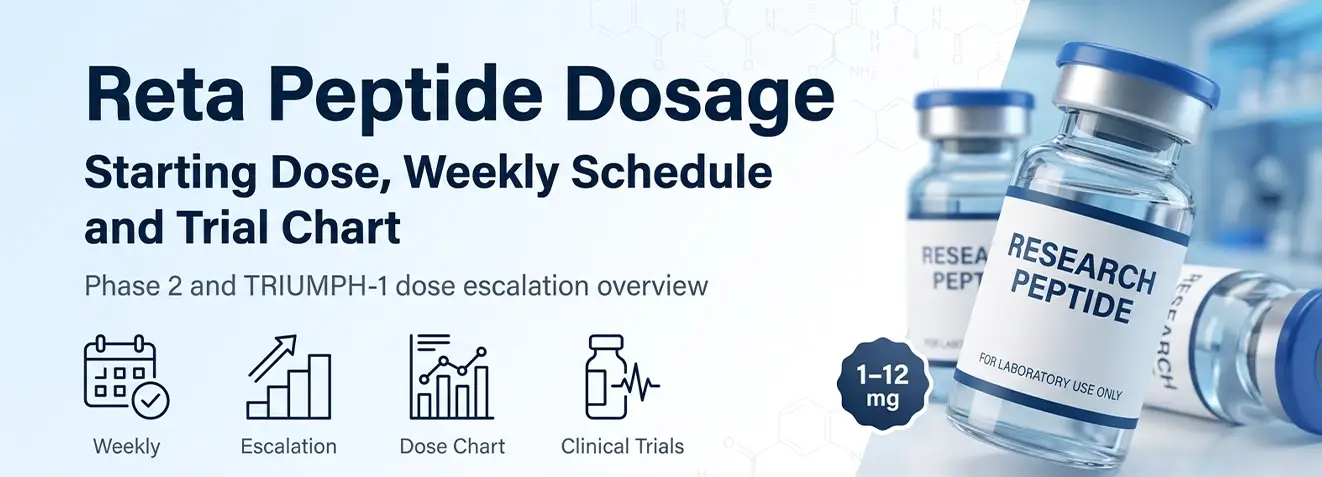
Reta peptide dosage has been evaluated in clinical trials using once-weekly injections, with different starting doses, escalation schedules and target doses across the research phases.
In TRIUMPH-1, participants started at 2 mg once weekly and increased the dose every four weeks towards targets of 4 mg, 9 mg or 12 mg. Earlier Phase 2 research evaluated target doses of 1 mg, 4 mg, 8 mg and 12 mg.
This guide compares the dosing schedules studied in both trials and examines how different dose levels influenced outcomes, side effects and treatment tolerability.
Reta Peptide Dosage at a Glance
- Frequency studied: Once weekly
- TRIUMPH-1 starting dose: 2 mg
- Escalation interval: Every four weeks
- Phase 2 target doses: 1 mg, 4 mg, 8 mg and 12 mg
- TRIUMPH-1 target doses: 4 mg, 9 mg and 12 mg
- Highest target dose studied: 12 mg once weekly
- Approved therapeutic dose: None currently
What Reta Peptide Dosages Were Studied in Clinical Trials?
Clinical trials have evaluated retatrutide target doses ranging from 1 mg to 12 mg once weekly. The exact schedule depended on the study phase and assigned group.
The 48-week Phase 2 obesity trial compared:
- A fixed 1 mg weekly dose
- A 4 mg target reached from a 2 mg starting dose
- A fixed 4 mg starting and target dose
- An 8 mg target reached from a 2 mg or 4 mg starting dose
- A 12 mg target reached from a 2 mg starting dose
TRIUMPH-1 later evaluated weekly targets of 4 mg, 9 mg and 12 mg. All active groups started at 2 mg and moved through scheduled increases every four weeks.
This difference between a starting dose and a target dose is important. The target identifies the dose participants were assigned to reach; it does not mean they received that amount from the first week.
Explore the Australia Peptide Sciences research peptide shop to discover compounds available for laboratory research.
What Is the Starting Dose of Reta Peptide in Clinical Trials?
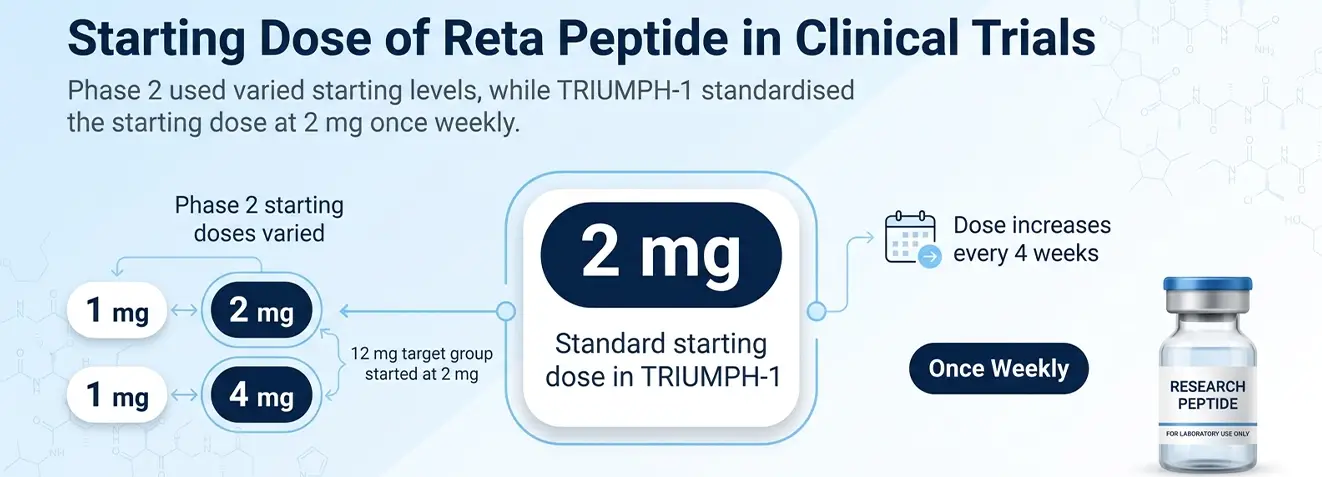
The starting dose of Reta peptide varied in Phase 2, but TRIUMPH-1 used a standard 2 mg starting dose for all retatrutide groups.
1. In Phase 2
- The 1 mg group started and remained at 1 mg.
- Selected 4 mg and 8 mg groups started at either 2 mg or 4 mg.
- The 12 mg group started at 2 mg.
2. In TRIUMPH-1
- The 4 mg, 9 mg and 12 mg groups all started at 2 mg once weekly.
- Dose increases occurred at four-week intervals until each group reached its assigned target.
Researchers used different starting levels in Phase 2 to examine whether early exposure affected both outcomes and tolerability. The later Phase 3 design standardised the starting level at 2 mg.
What Retatrutide Escalation Schedule Was Used?
Retatrutide dose escalation in the major obesity trials occurred at four-week intervals, with the number of steps determined by the assigned target dose.
In TRIUMPH-1, participants started at 2 mg once weekly before progressing through scheduled dose levels toward targets of 4 mg, 9 mg or 12 mg. Phase 2 used several starting-dose and target-dose combinations, allowing researchers to examine how different escalation approaches affected outcomes and tolerability.
Each escalation sequence was specific to its trial protocol and should be interpreted within that study design.
How Long Is a Reta Peptide Cycle?
Clinical trials used defined treatment periods rather than a conventional on-and-off Reta peptide cycle. Retatrutide was administered once weekly for 48 weeks in Phase 2 and 80 weeks in TRIUMPH-1, with an eligible subgroup continuing to week 104.
These durations reflect monitored trial exposure and do not establish how long retatrutide should be used outside a clinical-trial protocol.
Reta Peptide Dosage Chart: Phase 2 vs Phase 3
This Reta peptide dose chart summarises the weekly dose groups evaluated in Phase 2 and TRIUMPH-1.
| Trial | Starting dose | Target dose | Escalation |
| Phase 2 | 1 mg | 1 mg | Fixed dose |
| Phase 2 | 2 mg or 4 mg | 4 mg | Fixed or increased every four weeks |
| Phase 2 | 2 mg or 4 mg | 8 mg | Increased every four weeks |
| Phase 2 | 2 mg | 12 mg | Increased every four weeks |
| TRIUMPH-1 | 2 mg | 4 mg | Four weeks at 2 mg before target |
| TRIUMPH-1 | 2 mg | 9 mg | Four-week steps through 4 mg and 6 mg |
| TRIUMPH-1 | 2 mg | 12 mg | Four-week steps through 4 mg, 6 mg and 9 mg |
Phase 2 included 338 adults and tested a wider range of starting doses, while TRIUMPH-1 enrolled 2,339 participants and used a consistent 2 mg starting dose.
Phase 2 findings are peer-reviewed, while the TRIUMPH-1 figures cited here were initially reported by Eli Lilly and subsequently presented at the ADA Scientific Sessions 2026. As of 5 August 2026, TRIUMPH-1 had been presented at ADA 2026 but had not yet appeared as a full peer-reviewed publication.
For further details, read the APS guide to retatrutide Phase 3 results.
What Was the Maximum Retatrutide Dose Studied?
Within the broader field of GLP-1 peptide, the highest retatrutide target dose evaluated in the major Phase 2 and TRIUMPH-1 obesity trials was 12 mg once weekly. It was reached through gradual escalation rather than administered from the first week.
A maximum target dose is not the same as a recommended or approved dose. It identifies the upper study group evaluated under the trial’s eligibility rules, monitoring procedures and dose-adjustment criteria.
What Is Retatrutide and Why Does Dose Selection Matter
Explore Australia Peptide Sciences for research peptides, detailed product information and evidence-based scientific resources.
How Did Reta Peptide Dosage Affect Study Outcomes?
Phase 2 showed progressively greater average body-weight reductions across the higher target-dose groups at 48 weeks.
| Phase 2 group | Mean body-weight change at 48 weeks |
| 1 mg target | -8.7% |
| 4 mg target, 2 mg starting dose | -16.3% |
| 4 mg target, 4 mg starting dose | -17.8% |
| 8 mg target, 2 mg starting dose | -21.7% |
| 8 mg target, 4 mg starting dose | -23.9% |
| 12 mg target, 2 mg starting dose | -24.2% |
| Placebo | -2.1% |
TRIUMPH-1 later reported average body-weight reductions of 19.0% at 4 mg, 25.9% at 9 mg and 28.3% at 12 mg after 80 weeks.
Under Lilly’s efficacy estimand, mean body-weight change at week 80 was -19.0% with 4 mg, -25.9% with 9 mg and -28.3% with 12 mg, compared with -2.2% with placebo.
| TRIUMPH-1 target dose | Reported mean body-weight change at 80 weeks |
| 4 mg | -19.0% |
| 9 mg | -25.9% |
| 12 mg | -28.3% |
The findings show a dose-response pattern within each trial, but the Phase 2 and TRIUMPH-1 percentages should not be treated as a direct comparison.
The studies differed in duration, sample size, design and evidence maturity, and the figures represent group averages rather than individual outcomes.
How Did Retatrutide Dose Affect Side Effects and Tolerability?
In TRIUMPH-1, adverse-event discontinuation increased with the target dose among retatrutide groups:
| Target dose | Discontinuation due to adverse events |
| 4 mg | 4.1% |
| 9 mg | 6.9% |
| 12 mg | 11.3% |
| Placebo | 4.9% |
In Phase 2, adverse events affected 73% to 94% of participants receiving retatrutide, compared with 70% receiving placebo. The most common were nausea, diarrhoea, vomiting and constipation, with most gastrointestinal events classified as mild to moderate.
These events occurred mainly during dose escalation and were generally more frequent at higher doses. Participants starting at 4 mg also experienced more gastrointestinal events than those starting at 2 mg. Dose-related increases in heart rate peaked at week 24 before declining.
TRIUMPH-1 reported a similar gastrointestinal pattern, along with dysaesthesia, or altered skin sensation. Overall, the higher target doses produced greater average weight reductions but also had higher discontinuation rates.
Read the APS guide to Reta peptide side effects for a detailed review of the safety findings.
What Is Retatrutide and Why Does Dose Selection Matter?
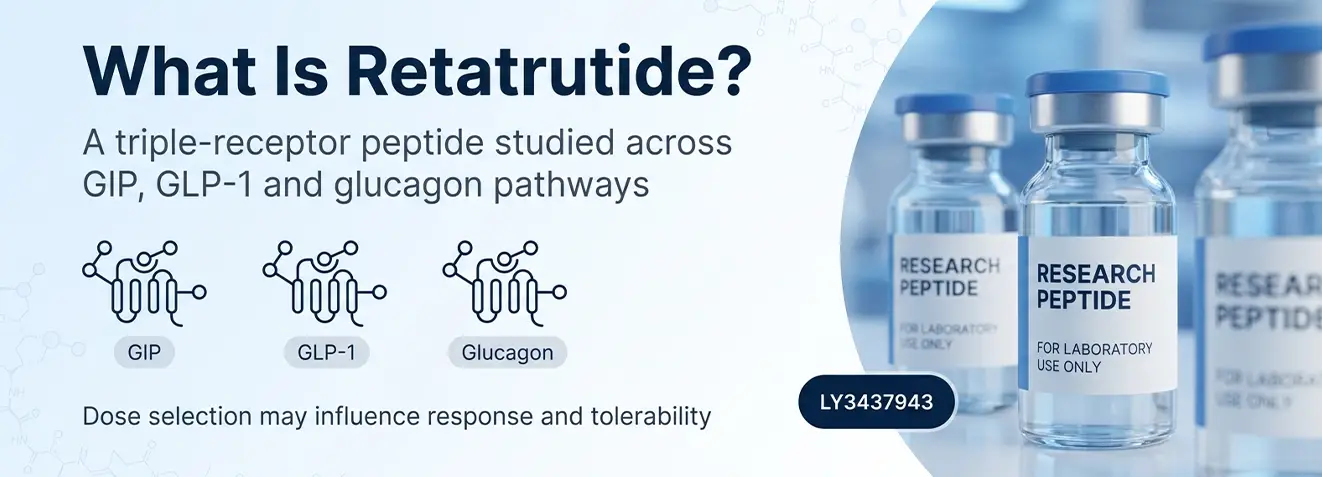
Retatrutide, also known as LY3437943, is a synthetic peptide designed to activate three receptor pathways:
- GIP receptors
- GLP-1 receptors
- Glucagon receptors
This combined activity is being studied in relation to appetite signalling, glucose regulation, energy intake and metabolism.
For comparison with a dual incretin agonist, researchers can review Tirzepatide peptide, which acts through GIP and GLP-1 receptors.
A fuller explanation of the compound’s mechanism and development history is available in What Is Reta Peptide?
Dose selection matters in research because the starting level, escalation period, target level, and duration of exposure may influence both the measured outcome and the frequency of adverse events.
A larger numerical dose does not by itself establish the most appropriate balance between response and tolerability.
What Does a Reta Peptide Dosage Calculator Calculate?
A Reta peptide dosage calculator performs mathematical conversions based on the values entered by the user. Depending on the tool, it may calculate:
- Laboratory solution concentration
- The volume containing a specified mass
- Conversions between known measurement units
These calculations explain the numerical relationship between concentration, mass, and volume. However, they cannot determine whether a particular human dose is appropriate, because retatrutide remains investigational and has no regulator-approved dosing formula or official product information.
In this context, dosage calculators are limited to laboratory concentration and unit conversions rather than human dosing or personalised clinical guidance.
Retatrutide Dosing: Key Findings
Clinical trials evaluated once-weekly retatrutide doses ranging from 1 mg to 12 mg. Phase 2 tested several starting-dose combinations, while TRIUMPH-1 used a consistent 2 mg starting dose followed by four-week escalation towards targets of 4 mg, 9 mg or 12 mg.
Higher target doses were associated with greater average weight reductions, but they also produced more side effects and higher discontinuation rates.
The trial data do not identify an optimal dose: groups with greater mean weight reduction also recorded more adverse events and treatment discontinuations.
Researchers comparing retatrutide with related dual-pathway compounds can also review Mazdutide peptide, which targets GLP-1 and glucagon receptors.
Explore Retatrutide for laboratory research → View specifications, pricing and Certificates of Analysis.
FAQs About Reta Peptide Dosage
What Starting Dose Was Used in Retatrutide Clinical Trials?
Starting doses varied in Phase 2, while all TRIUMPH-1 retatrutide groups began at 2 mg once weekly before escalation.
How Did Reta Peptide Dosing Differ Between Phase 2 and Phase 3?
Phase 2 tested several starting and target-dose combinations, whereas TRIUMPH-1 used a 2 mg starting dose with increases every four weeks.
What Was the Maximum Target Dose Tested in TRIUMPH-1?
The highest target dose was 12 mg once weekly, reached through protocol-defined four-week escalation steps.
Do Higher Retatrutide Doses Guarantee Better Weight-Loss Results?
No; higher doses produced greater average reductions in the trials, but individual outcomes varied and tolerability also changed with dose.
What Side Effects Were Common at Higher Retatrutide Doses?
The most common events were nausea, diarrhoea, vomiting and constipation, while dysaesthesia was also reported in TRIUMPH-1.
Why Were Discontinuation Rates Higher in Some Dose Groups?
In TRIUMPH-1, adverse-event discontinuation increased from 4.1% at 4 mg to 6.9% at 9 mg and 11.3% at 12 mg.
Can a Reta Peptide Dosage Calculator Select an Appropriate Dose?
No validated calculator can select a human dose because online tools provide mathematical conversions rather than clinical assessments.
How Often Was Retatrutide Administered in Clinical Trials?
The obesity trials discussed in this guide administered retatrutide by subcutaneous injection once weekly.
Is There an Approved Retatrutide Dose in Australia or Elsewhere?
No; retatrutide remains investigational and has no TGA-approved therapeutic dose or established prescribing schedule.
How Does Tolerability Affect Retatrutide Dose Selection?
Trial findings show that dose evaluation must balance the measured response against adverse events and treatment discontinuation.
What dose arms were tested in the retatrutide Phase 2 trial?
The Phase 2 obesity trial investigated a 1 mg fixed group, 4 mg targets starting at either 2 mg or 4 mg, 8 mg targets starting at either 2 mg or 4 mg, and a 12 mg target starting at 2 mg. These were protocol-defined trial arms, not dosing recommendations.
How did dose escalation work in the clinical trials?
Phase 2 used several starting-dose and target-dose combinations. In TRIUMPH-1, all active treatment groups began at 2 mg and escalated at four-week intervals towards their assigned 4 mg, 9 mg or 12 mg targets. These schedules describe clinical trial protocols only.
References
- Jastreboff AM, Kaplan LM, Frías JP, et al. Triple-Hormone-Receptor Agonist Retatrutide for Obesity. New England Journal of Medicine. 2023;389:514-526. doi:10.1056/NEJMoa2301972.
- gov. TRIUMPH-1 Study Record, NCT05929066. Accessed 5 August 2026.
- Eli Lilly and Company. TRIUMPH-1 Phase 3 Results and Study Design. Published 21 May 2026.
- Therapeutic Goods Administration. Understanding Your Responsibilities When Importing, Compounding and Supplying Unapproved Peptide Products. Published 13 April 2026.