
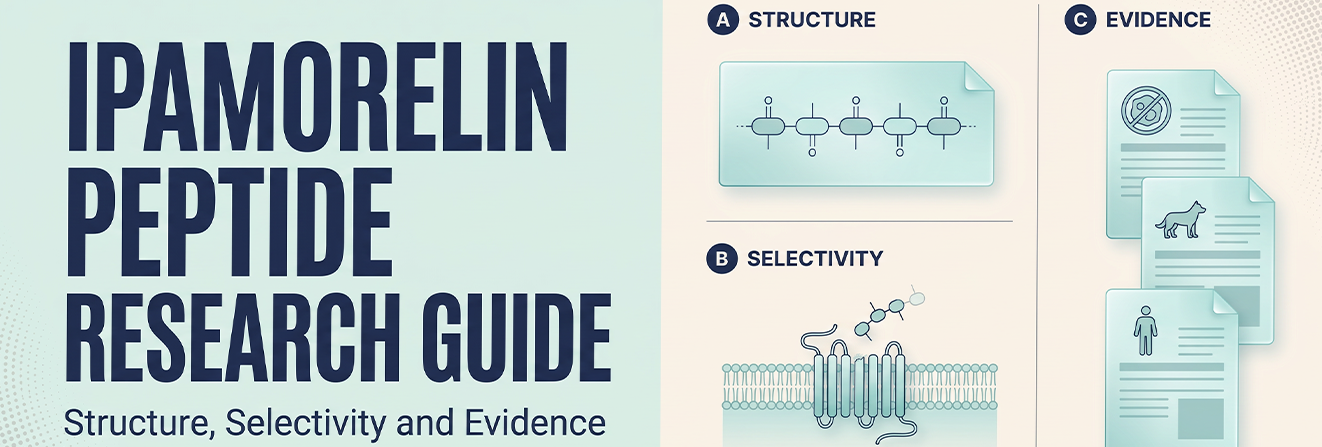
Ipamorelin is a synthetic five-residue peptide studied for ghrelin-receptor activation and growth hormone release. This guide covers its structure, selectivity, human pharmacokinetics, and clinical evidence.
Research Use Only (RUO): this article is for scientific information and does not provide human or veterinary use guidance.
Quick Answer: What Is Ipamorelin?
Ipamorelin is a synthetic pentapeptide and a growth hormone secretagogue, a compound that stimulates growth hormone (GH) release. It acts as a GHS-R1a agonist, meaning it activates the ghrelin receptor. A swine study found that adrenocorticotrophic hormone (ACTH) and cortisol responses did not differ significantly from growth hormone-releasing hormone (GHRH) stimulation. Early human research showed a short-term GH response, while a Phase II trial found no statistically significant improvement in its key postoperative ileus endpoint.
The Structure of the Ipamorelin Peptide
The published sequence of the ipamorelin peptide is Aib-His-D-2-Nal-D-Phe-Lys-NH₂. The terminal - NH₂ indicates an amidated carboxyl end; it does not add a sixth residue.
1. What the sequence notation tells you
Aib is α-aminoisobutyric acid; His is histidine; D-2-Nal and D-Phe are D-isomers; and Lys is lysine. The D-isomers affect stereochemistry, which matters when comparing peptide identity across studies.
2. How ipamorelin emerged from GHRP-1 research
Raun and colleagues identified ipamorelin in compounds that lacked the central alanine-tryptophan pair of growth hormone-releasing peptide 1 (GHRP-1). The sequence identifies the compound, while pharmacology assays show its activity in defined models.
How Ipamorelin Activates the Ghrelin Receptor
1. The receptor and the hormone response
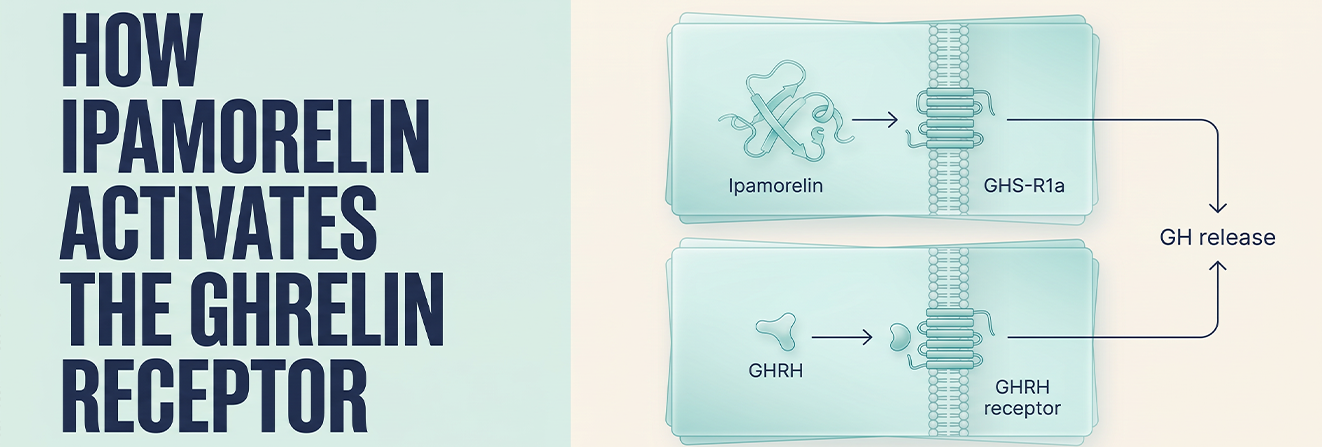
The growth hormone secretagogue receptor type 1a (GHS-R1a) is a G protein-coupled receptor that ghrelin naturally activates. As a synthetic ghrelin receptor agonist, ipamorelin can activate it and stimulate GH release.
Receptor assays measure signalling, pituitary-cell assays measure GH release, and blood samples measure circulating hormone. These readouts describe different stages of the response. For a broader ghrelin-leptin comparison, see the related research article.
2. How the GHS-R1a and GHRH pathways differ
GHRH stimulates GH release through its own receptor, whereas ipamorelin and growth hormone-releasing peptide-6 (GHRP-6) act through the GHRP-sensitive pathway. The CJC-1295 research guide explains the GHRH receptor side of this comparison.
An acute GH measurement supports a conclusion about GH during that sampling window. An effect on insulin-like growth factor 1 (IGF-1) requires separate measurements over an appropriate observation period.
Ipamorelin vs GHRP-6: What Selectivity Means
The original ipamorelin vs GHRP-6 comparison assessed potency, maximum GH response and changes in other hormones. The table separates the models and endpoints.
| Model and endpoint (source) | Ipamorelin | GHRP-6 |
| Primary rat pituitary cells - half-maximal GH release concentration (Raun et al., 1998) | 1.3 ± 0.4 nmol/L | 2.2 ± 0.3 nmol/L |
| Primary rat pituitary cells - maximum GH response, Emax (Raun et al., 1998) | 85 ± 5% of GHRP-6 reference | 100% reference |
| Conscious swine - ACTH and cortisol response (Raun et al., 1998) | Not significantly different from GHRH stimulation | Increased |
Potency is the concentration needed to reach a defined fraction of the maximum response. Emax, meaning maximum effect, is the largest response recorded in the assay. A lower potency concentration does not by itself mean a larger Emax.
Ipamorelin and GHRP-6 both elicited GH release, but their ACTH and cortisol profiles differed in the swine experiment. Here, selectivity refers to the hormone pattern measured in that animal model; it does not establish human selectivity or clinical benefit.
For a closer look at ipamorelin’s ghrelin receptor activity, human pharmacokinetics and the evidence on postoperative ileus, watch the ipamorelin discussion in the FDA advisory committee’s afternoon session.
What Does Ipamorelin Research Show?
1. Laboratory and animal evidence for GH release
The 1998 study measured GH release in rat pituitary cells and circulating GH in rats and swine. These models support classifying ipamorelin as a GH secretagogue, but their conditions do not support a single potency scale.
2. Gastric emptying in a rodent model of postoperative ileus
In a rat model of postoperative ileus, the treated group retained 52% ± 11% of a labelled meal in the stomach, compared with 78% ± 5% in the vehicle-control group. Less retention indicated faster emptying at that time point.
The isolated-tissue experiments also supported further study of gastric motility. However, a fixed-time animal measurement is not equivalent to recovery outcomes after bowel surgery in people.
3. Human pharmacokinetics and the acute GH response
Gobburu and colleagues measured ipamorelin concentrations and GH response in healthy male volunteers. The estimated terminal half-life was about two hours, with a GH peak around 40 minutes.
Half-life describes the decline of the peptide in circulation, while time to peak describes the hormone response. The study addressed short-term pharmacokinetics and pharmacodynamics, not sustained outcomes.
4. Phase II trial after bowel resection
Beck et al. (2014) ran a multicentre, double-blind Phase II trial after bowel resection. The trial enrolled 117 participants; 114 were included in the safety and modified intention-to-treat (mITT) analyses. The main endpoint was time to tolerate a standardised solid meal.
Median time to the first tolerated meal was 25.3 hours with ipamorelin and 32.6 hours with placebo. The difference was not statistically significant (p = 0.15), so the trial did not establish efficacy. The shorter median is an observed difference, not proof of a treatment effect.
The rodent and human studies measured different outcomes: gastric emptying in animals and meal tolerance after surgery in people. The animal result supported clinical investigation, but the Phase II trial did not confirm efficacy.
For broader research comparisons, review the GHRP peptide category alongside the study-specific evidence.
How to Evaluate Ipamorelin Research
1. Match the claim to the measurement
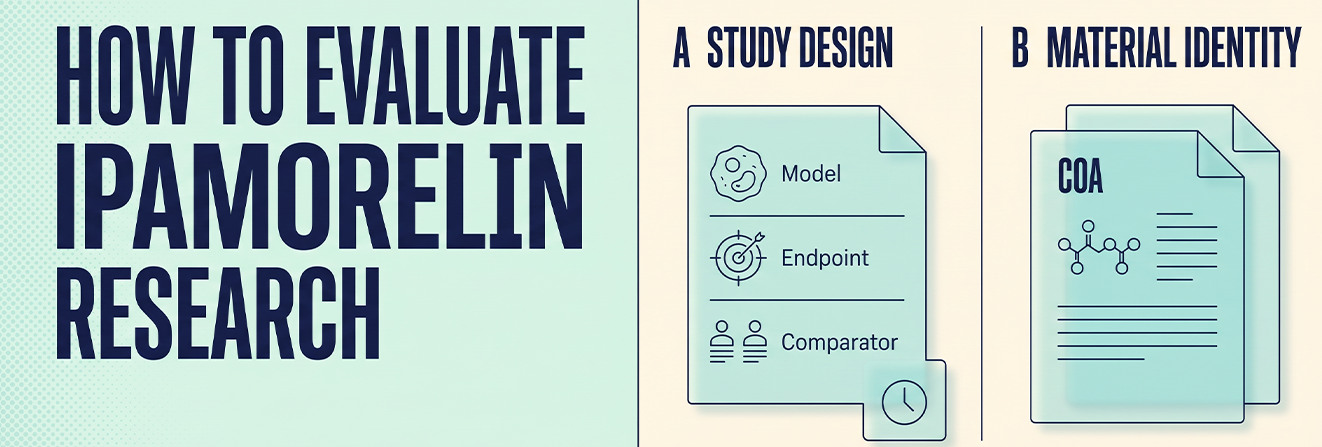
Start with the model, endpoint and comparator. how peptides work in research describes secretion under its conditions, while a placebo-controlled trial tests whether a clinical outcome differs from control.
Check the observation window and the reported variation, sample size and statistical result. Short studies describe short-term responses; sustained effects require longer follow-up.
2. Check what material the study actually tested
Check the peptide sequence, terminal modification and salt form. A certificate of analysis (COA) may support batch review, while mass spectrometry supports identity assessment and HPLC describes chromatographic purity under the stated method. The APS peptide COA guide explains these fields.
For a related comparator, see the GHRP-6 and verify its analytical documentation.
Also check whether the study tested ipamorelin alone or in a mixture. Results from a blend cannot be attributed to one component without an isolating design.
For the GHRH-pathway comparator, see the CJC-1295 and review the stated material specification.
Ipamorelin in Australia: Scheduling and Sport
For “ipamorelin Australia”, distinguish medicines scheduling, Australian Register of Therapeutic Goods (ARTG) registration and sport rules. The October 2026 Poisons Standard lists ipamorelin in Schedule 4, while unapproved products outside the ARTG have not been assessed by the Therapeutic Goods Administration (TGA) for safety, quality or effectiveness.
The 2026 World Anti-Doping Agency (WADA) Prohibited List names ipamorelin under S2.2.4, prohibited in and out of competition. WADA rules, the Poisons Standard and ARTG registration address separate questions.
Conclusion: What the Evidence Shows
Ipamorelin is a research tool for studying ghrelin receptor activation and growth hormone release. Animal studies support its reported selectivity, while human evidence remains limited and the Phase II efficacy trial was not statistically significant.
Explore Australia Peptide Sciences
Explore Ipamorelin for laboratory research → View specifications, pricing and Certificates of Analysis.
Frequently Asked Questions
What does “pentapeptide” mean?
It means the molecule contains five amino acid residues.
What does - NH₂ mean in the sequence?
It denotes an amide at the peptide’s C-terminus.
Is ipamorelin a form of growth hormone?
It is a secretagogue that stimulates GH release.
What is the difference between ghrelin and ipamorelin?
Ghrelin is an endogenous hormone, while ipamorelin is a synthetic agonist of its receptor.
Does a lower half-maximal concentration mean a larger response?
The concentration and the maximum describe different features of a response curve.
What does ACTH stand for?
It stands for adrenocorticotropic hormone.
What does terminal half-life describe?
It describes the time for the plasma concentration to halve during the terminal phase of its decline.
Can a GH measurement establish an effect on IGF-1?
Measure IGF-1 over a relevant observation period.
Does Schedule 4 status establish TGA approval?
Scheduling and therapeutic product registration are separate regulatory determinations.
Is ipamorelin prohibited outside competition?
Yes. WADA prohibits it both in and out of competition.
References
- Raun K, et al. (1998). Original characterisation of ipamorelin and its GH-release selectivity. European Journal of Endocrinology, 139(5), 552-561. DOI
- IUPHAR/BPS Guide to Pharmacology. Ghrelin receptor nomenclature and pharmacology.
- Greenwood-Van Meerveld B, et al. (2012). Ipamorelin and gastric dysmotility in a rodent model of postoperative ileus. Journal of Experimental Pharmacology, 4, 149-155. Full text
- Gobburu JV, et al. (1999). Pharmacokinetic-pharmacodynamic modelling of ipamorelin in human volunteers. Pharmaceutical Research, 16(9), 1412-1416. PubMed
- Beck DE, Sweeney WB and McCarter MD (2014). Randomised Phase II study of ipamorelin in postoperative ileus after bowel resection. International Journal of Colorectal Disease, 29(12), 1527-1534. PubMed
- Australian Government (2026). Therapeutic Goods (Poisons Standard, October 2026) Instrument 2026, Schedule 4.
- Therapeutic Goods Administration. How we regulate therapeutic peptide products.
- World Anti-Doping Agency (2026). 2026 Prohibited List, section S2.2.4.